
Bewick’s Wren vs House Wren


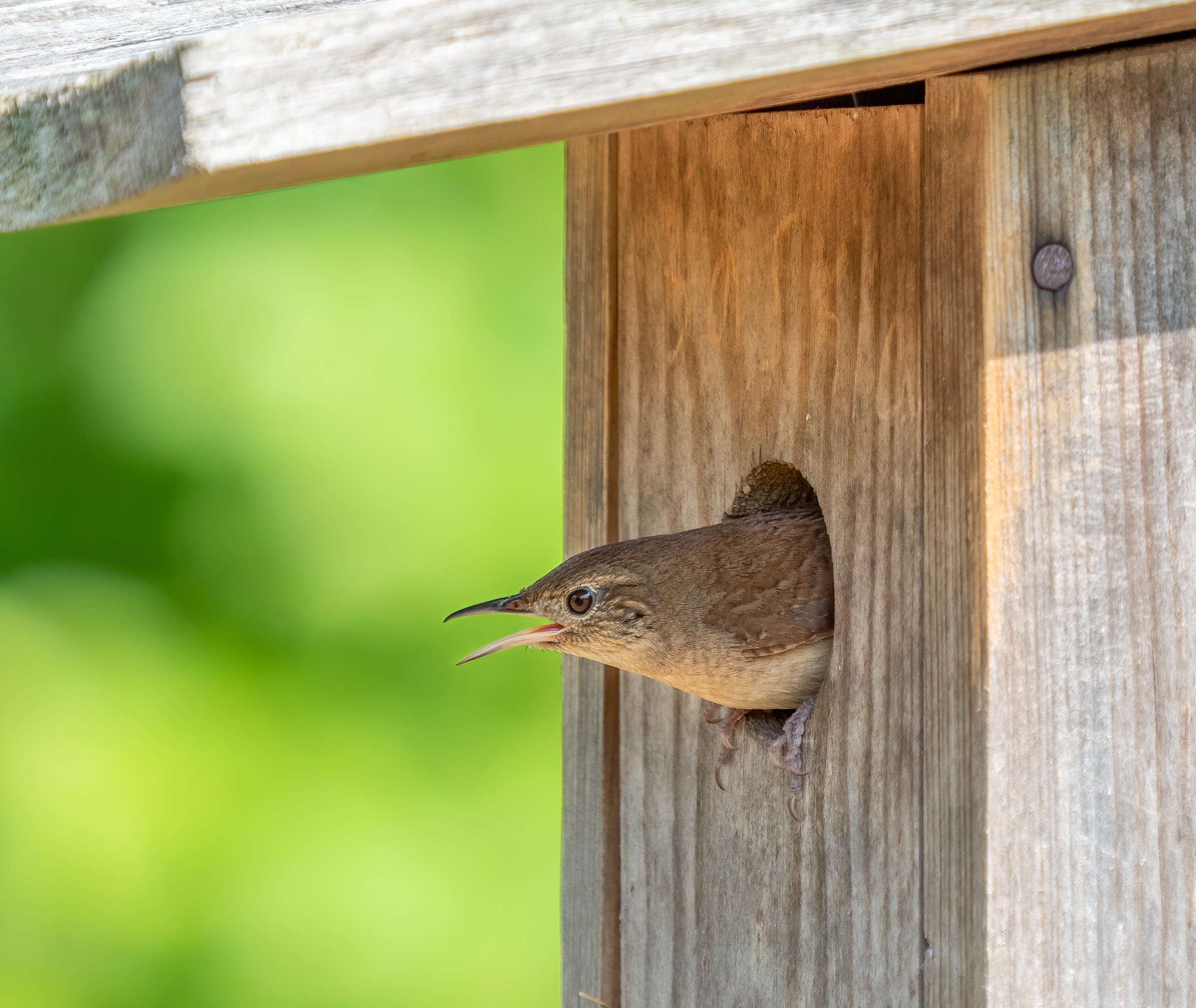

Bewick’s Wren vs House Wren (Thryomanes bewickii vs Troglodytes aedon): The Complete Backyard Identification Guide
Quick Answer: The Fastest Way to Tell Them Apart
The two wrens most likely to fight over your nest box. Three rules:
- Eyebrow: a bold white eyebrow stripe = Bewick’s; a plain face = House Wren.
- Tail: white corners flashing on a long flicked tail = Bewick’s; short, barred and plain = House Wren.
- Song: a buzzy, variable trill = Bewick’s; a bubbling, rushing cascade = House Wren.
At-a-Glance Comparison Table
The eyebrowed westerner and the plain brown boxer, side by side. KEY rows separate fastest.
| Feature | Bewick’s Wren | House Wren |
|---|---|---|
| Scientific Name | Thryomanes bewickii | Troglodytes aedon |
| Length KEY | 5.1 in (13 cm) | 4.7 in (12 cm) |
| Wingspan | 7.1 in (18 cm) | 5.9 in (15 cm) |
| Weight | 0.3–0.4 oz (8–12 g) | 0.3–0.4 oz (9–12 g) |
| Overall Shape | Slim, long-tailed wren with a bold white eyebrow | Small, plain brown wren with a thin, slightly decurved bill and a short tail often cocked up |
| Male Plumage KEY | Gray-brown above, whitish below, with a bold white eyebrow and a long, frequently flicked tail showing white corners (sexes alike) | Plain warm brown overall with faint barring on wings and tail, no eyebrow stripe (sexes alike) |
| Female Plumage | Identical to the male | Identical to the male |
| Bill Shape | Thin, slightly decurved, dark | Thin, dark, slightly decurved |
| Tail | Long, graduated, with white outer corners | Short, barred, habitually cocked |
| Core Range KEY | The West and Southwest in brushy edges and yards; formerly eastern, now nearly gone east of the Plains | Breeds across most of North America; winters in the southern U.S. and Mexico |
| Migration | Mostly resident; northern birds shift south | Migrant — northern birds winter in the South; a backyard nester everywhere |
| Feeder Presence | Visits suet crumbles and mealworms near brush piles and dense shrubs | Ignores seed but nests in boxes and hunts insects around the yard |
| Favorite Foods | Insects and spiders from bark and litter | Insects and spiders almost entirely |
| Song KEY | A variable, buzzy trill — each male learns several local song types | A bubbling, rushing cascade of notes that rises and falls |
| Flight Call | A flat “jip” and scolding chatters | A harsh scolding chatter |
| Population Trend | Stable in the West; sharply declined in the East, partly to House Wren competition | Stable and abundant; the classic backyard nest-box wren |
Male Field Marks, Side by Side
Bewick’s Wren — Male
- Bold white eyebrow on a slim gray-brown body.
- Long tail with white corners, flicked side to side.
- Learns multiple song types from neighbors.
House Wren — Male
- Plain brown, no eyebrow, short barred tail.
- Sings a bubbling cascade from a prominent perch.
- Stuffs nest boxes and cavities full of twigs.
Female & Juvenile Marks, Side by Side
Bewick’s Wren — Female
- Identical to the male.
- Nests in any cavity — boxes, cans, pockets of machinery.
- Scolds from inside brush piles.
House Wren — Female
- Identical to the male — both sexes look alike.
- Female adds a soft lining inside the twig mound.
- Fiercely defends the nest site despite her size.
Part-by-Part Anatomy Breakdown
Every part offers a check:
| Body Part | Bewick’s Wren | House Wren |
|---|---|---|
| Eyebrow | Bold white stripe | None — plain face |
| Tail | Long, graduated, white outer corners | Short, barred, no white |
| Underparts | Whitish | Plain brown-buff |
| Build | Slim, long-tailed | Compact, short-tailed |
| Nest Box | Uses boxes with 1.25-in holes | Fills boxes to the roof with twigs |
| Range | West and Southwest | Nearly continent-wide |
| Song | Variable buzzy trill | Bubbling, rushing cascade |
Song & Call Comparison
Bewick’s Wren
Song: a variable, buzzy trill — every male sings several learned local variants.
Calls: a flat jip and harsh scolding chatters.
House Wren
Song: a bubbling, rushing cascade of jumbled notes.
Calls: a harsh scolding churr and rattles.
Range & Seasonal Presence
Bewick’s Wren holds brushy edges and yards across the West and Southwest — and has nearly vanished from the East, where the House Wren is a prime suspect.
The House Wren breeds across most of the continent and winters in the South. It is the classic nest-box wren, famous for stuffing boxes with twigs and puncturing the eggs of neighbors.
Feeder Behavior & Favorite Foods
- Bewick’s Wren: suet crumbles and mealworms near dense cover.
- House Wren: ignores seed but nests in boxes and hunts insects all over the yard.
- Nest boxes: both take small boxes; expect competition — House Wrens usually win.
- Cover: brush piles and dense shrubs benefit both.
Temperament & Flock Behavior
Bewick’s Wrens are furtive fidgets — tail flicking, white corners flashing, scolding from inside a shrub.
House Wrens are pugnacious landlords — singing from the box roof, evicting rivals, and singing again before the twigs settle.
6-Step Backyard ID Checklist
- Eyebrow. Bold white = Bewick’s; plain = House Wren.
- Tail. White corners = Bewick’s; plain barred = House Wren.
- Belly. Whitish = Bewick’s; brown-buff = House Wren.
- Song. Buzzy trill = Bewick’s; bubbling cascade = House Wren.
- Range. West = likely Bewick’s; elsewhere = House Wren.
- Box behavior. Stuffs box with twigs to the entrance = House Wren.
Frequently Asked Questions
- Eyebrow: Bold white = Bewick’s; none = House Wren.
- Tail: White corners = Bewick’s; plain = House Wren.
- Song: Buzzy trill = Bewick’s; bubbling cascade = House Wren.
- Range: West = Bewick’s; widespread = House Wren.
- Box Style: Twig mountain = House Wren.
- Conflict: House Wrens usually win the nest-box wars.