
Ash-throated Flycatcher


Ash-throated Flycatcher (Myiarchus cinerascens): Complete Identification, Habitat Guide & Sound Library
Quick Answer: How to Attract & Identify the Ash-throated Flycatcher
The Ash-throated Flycatcher (Myiarchus cinerascens) is the crested flycatcher of the dry West — big-headed and shaggy-crested, ash-gray on the throat, pale lemon on the belly, with rufous flashing in the wings and tail. It hunts insects by sallying from exposed perches and nests in cavities — including backyard nest boxes. The voice is a rolling ka-brick and a dawn prrit chorus. Remarkably, it never drinks water, getting moisture from prey. Western yards attract them with nest boxes, open perches, and spray-free insect life. They share the dry woods with the Say’s Phoebe and the Western Kingbird.
Species Physical Profile & Morphometrics
The Ash-throated Flycatcher belongs to the tyrant flycatcher family (Tyrannidae) and is the common Myiarchus of the arid West — open woodland, desert scrub, and ranch country from Washington to Texas, wintering in Mexico and Central America.
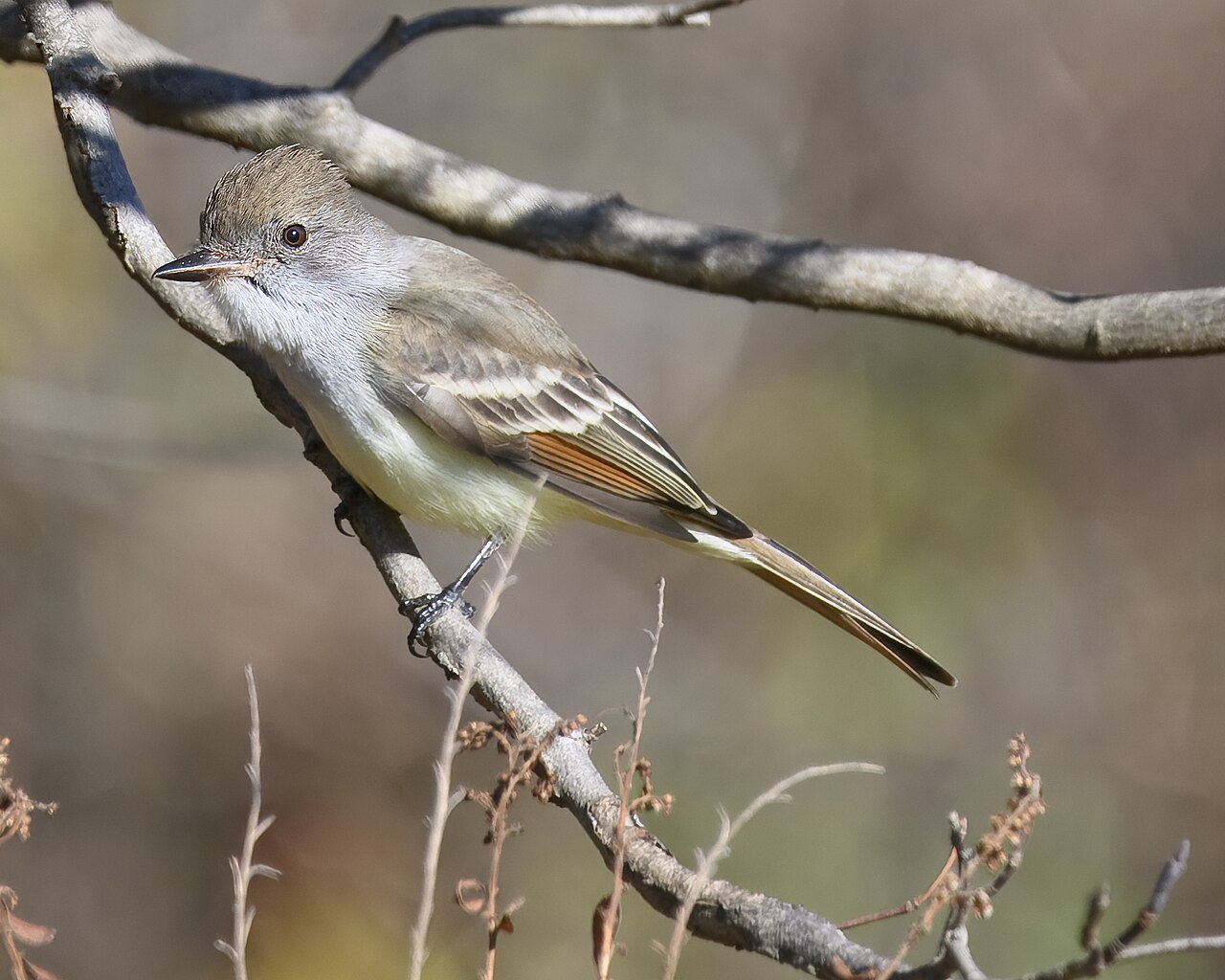
The identification formula: crested big head + ash-gray throat + pale yellow belly + rufous in wings and tail. The similar Great Crested Flycatcher is eastern and shows a bright yellow belly and darker gray throat; the Ash-throated is paler, drier-country, and far quieter at midday.
Essential Morphometric Field Marks:
- Body Length & Mass: 7.5 to 8.7 inches (19–22 cm) and 0.7 to 1.3 ounces (21–37 grams) — a mid-sized flycatcher with a big head and shaggy crest.
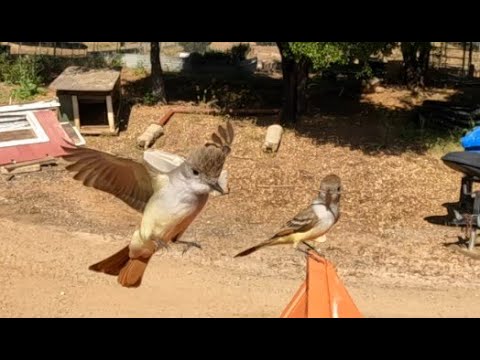
- Wingspan: 11.8 to 12.6 inches (30–32 cm); flight is quick sallies from a perch — out, snap, and back — with rufous panels flashing.
- Bill Structure & Color: A broad, flat black bill with a hooked tip, wide at the base — an insect trap backed by rictal bristles.
- Color Pattern: Gray-brown head and back, ashy throat and breast, pale lemon belly, and rich rufous edging in wings and tail — subtle perched, warm in flight.
- Male vs. Female: The sexes look alike — both wear the crest; pairs defend the nest cavity together, the male doing most of the loud talking.
The crested watchman: perched dead-still on a bare branch, then exploding into a sally after a grasshopper — back on the perch before you finish blinking.
Identically crested — she furnishes the cavity nest with grass, fur, and the traditional shed snakeskin, and hawks insects for the chicks from dawn to dusk.
Ash-throated Flycatcher Vocalization Guide (0 Field Recordings)
The Ash-throated Flycatcher’s voice is a rolling ka-brick and a burry prrit — plus a varied dawn chorus. All recordings below are real field audio via Wikimedia Commons — no simulations. For a deeper library, browse xeno-canto: Ash-throated Flycatcher.
1. The Ka-Brick
2. The Dawn Chorus
3. The Burry Prrit
Habitat, Range & the Dry West
The Ash-throated Flycatcher lives in dry open country: desert scrub, oak and juniper woodland, ranchland, and riverside groves across the West. It is the rare flycatcher that thrives in arid country — and the rare western bird that readily nests in backyard boxes.

The Dry Country’s Box Nester
Breeding range spans the western half of the country from Washington to Texas; winter takes most of the population to Mexico and Central America, with a few lingering in the warmest Southwest corners.
For backyard birders: rural and desert-edge yards with open perches and a nest box can host a pair each spring — a box-mounted pair hawks insects over your garden all summer.
Backyard Behavioral Patterns & Social Dynamics
The Ash-throated Flycatcher is a perch-and-pounce hunter with a box-nesting habit. Four behaviors explain most of what you will observe:
🎯 The Sally Hunter
It hunts by sallying from an exposed perch — snatching insects from the air or foliage and returning to the same lookout; the perch, not the sky, is where you find it.
🏠 The Box Nester
It nests in cavities and readily accepts nest boxes — one of the West’s few box-nesting insect-eaters, a gift to the desert gardener.
🐍 The Snakeskin Tradition
Nests are famously lined with shed snakeskin (or plastic wrap as a modern substitute) — nobody knows exactly why, but the habit is ancient.
💧 The Water-Free Life
It almost never drinks — prey supplies all moisture; a flycatcher truly built for the dry country it rules.
Problem: “How Do I Tell Ash-throated from Other Crested Flycatchers? What Should I Do?”
The three most common Ash-throated Flycatcher puzzles all have proven answers:
First, the Myiarchus muddle: compare belly color and geography — Ash-throated is pale lemon below with a pale ashy throat and lives in the dry West; Great Crested is brighter yellow with a darker throat and lives east; Brown-crested (borderlands) has a heavier bill and brighter tail. Second, the invisible noon: the birds go silent and still in midday heat — watch at dawn and late afternoon when sallying and calling resume. Third, the empty nest box: boxes get refused when perches are missing — add a bare hunting branch within 20 feet of the box, face the entrance away from prevailing wind, and the spring prospectors will stop to stay.
Method 1: Set the Table — Nest Box & Hunting Perches
Design for a cavity-nesting insect hunter:
-
Mount a Nest Box
A box with a 2-inch entrance at 8–12 feet on a post or tree — cleaned out each February before spring prospecting.
-
Provide Hunting Perches
Bare dead branches in the open — sallying posts are the office from which the bird works your yard.
-
Keep Insects Plentiful
No broad insecticides — grasshoppers, beetles, and moths are the whole diet; a spray-free yard is a stocked larder.
-
Leave the Snakeskins
Shed snakeskin near the box is nest lining — a quirk to celebrate, not tidy away.
Method 2: Build the Habitat — Scattered Trees & Native Prey
Keep the country open and buggy, and the pair returns each spring:
-
Keep Scattered Mature Trees
Oaks, junipers, and mesquite with dead branches — perches, cavities, and shade in one structure.
-
Leave Standing Snags
Natural cavities in snags are the original nest sites — a safe snag is a flycatcher duplex.
-
Grow the Insect Crop
Native grass and wildflower patches raise the grasshoppers and beetles the nestlings need by the hundred.
-
Watch the Dawn Window
Dawn and dusk are activity peaks — midday silence is normal desert scheduling, not absence.
Tool Solution: Recommended Hardware for Ash-throated Flycatcher
Equipment matched to a box-nesting western flycatcher:
Cavity Nest Box
A 2-inch-entrance box at 8–12 feet near open perches — the invitation that brings a hunting pair to your yard each spring.
- • Entrance: 2 inches
- • Height: 8–12 feet
- • Cleaning: Every February
Dead Branch Perches
Bare snags and dead limbs in the open — the sallying posts every Myiarchus territory requires.
- • Structure: Bare, exposed
- • Placement: Open sightlines
- • Bonus: Phoebes & kingbirds too
Native Grass & Flower Patch
Unsprayed native vegetation — the grasshopper farm that feeds a flycatcher family all summer.
- • Plants: Native grasses, forbs
- • Rule: No insecticides
- • Bonus: Sparrows & quail too
Frequently Asked Questions
- Species Profile: The Ash-throated Flycatcher (Myiarchus cinerascens) is a 7.5–8.7 inch, 0.7–1.3 ounce flycatcher (Tyrannidae), band code ATFL — the crested hunter of the dry West.
- ID in One Look: Shaggy crest, ashy throat, pale lemon belly, rufous wing flash.
- The Sound: Rolling ka-brick calls and a pre-dawn burry chorus; real field recordings above.
- Range & Habit: Western dry country April–September; nests in cavities and boxes; never needs to drink.
- Feeder Formula: A nest box, bare perches, and an unsprayed insect crop — no seed required.
- The Snakeskin Custom: Shed snakeskin in the nest is tradition — the strangest decorating habit in your yard.
Bird Watching Log
Species: Ash-throated Flycatcher (Myiarchus cinerascens)
| Ash-throated Flycatcher (Crest Seen: Yes / No — Rufous Flash: Yes / No — Ka-Brick Heard: Yes / No — Box Occupied: Yes / No — Date & Time: ___) | |