
European Starling


European Starling (Sturnus vulgaris): Complete Identification, Feeder Management & Song Library
Quick Answer: How to Identify & Manage European Starlings
The European Starling (Sturnus vulgaris) is the stocky, short-tailed, iridescent bird with the long pointed bill — glossy purple-green with a yellow bill in spring, speckled like a constellation with a dark bill in winter. Descended from about 100 birds released in Central Park in 1890–91, it now numbers in the hundreds of millions and lives year-round across the continent. It is a gifted mimic and a spectacular flocker — and an aggressive competitor that empties suet feeders and seizes nest cavities from native birds. Manage it with upside-down suet feeders, caged tube feeders, safflower seed, and 1.5-inch entrance holes on bluebird boxes.
Species Physical Profile & Morphometrics
The European Starling belongs to the starling family (Sturnidae) and is the only member of that family established in North America. At feeders it is confused most often with blackbirds — the Common Grackle, Red-winged Blackbird, and Brewer’s Blackbird — but its short tail, triangular wings, and long probing bill set it apart instantly once you know the shape.
The identification formula: stocky body + very short squared tail + long pointed bill + strutting walk. Add purple-green gloss and yellow bill in spring, or heavy white speckling and dark bill in winter, and no other bird matches.
Essential Morphometric Field Marks:
- Body Length & Mass: 7.9 to 9.1 inches (20–23 cm) and 2.1 to 3.4 ounces (58–101 grams) — chunky and robin-sized, but the short tail makes it look compact beside any blackbird.
- Wingspan & Flight: 12.2 to 15.8 inches (31–40 cm); flight is fast and direct on short, triangular wings, and flocks wheel in tight, synchronized masses — the murmuration shape.
- Bill Structure & Color: A long, slender, sharply pointed bill, bright yellow in breeding season and dark gray-brown in winter — built for the species’ signature open-bill probing of turf.
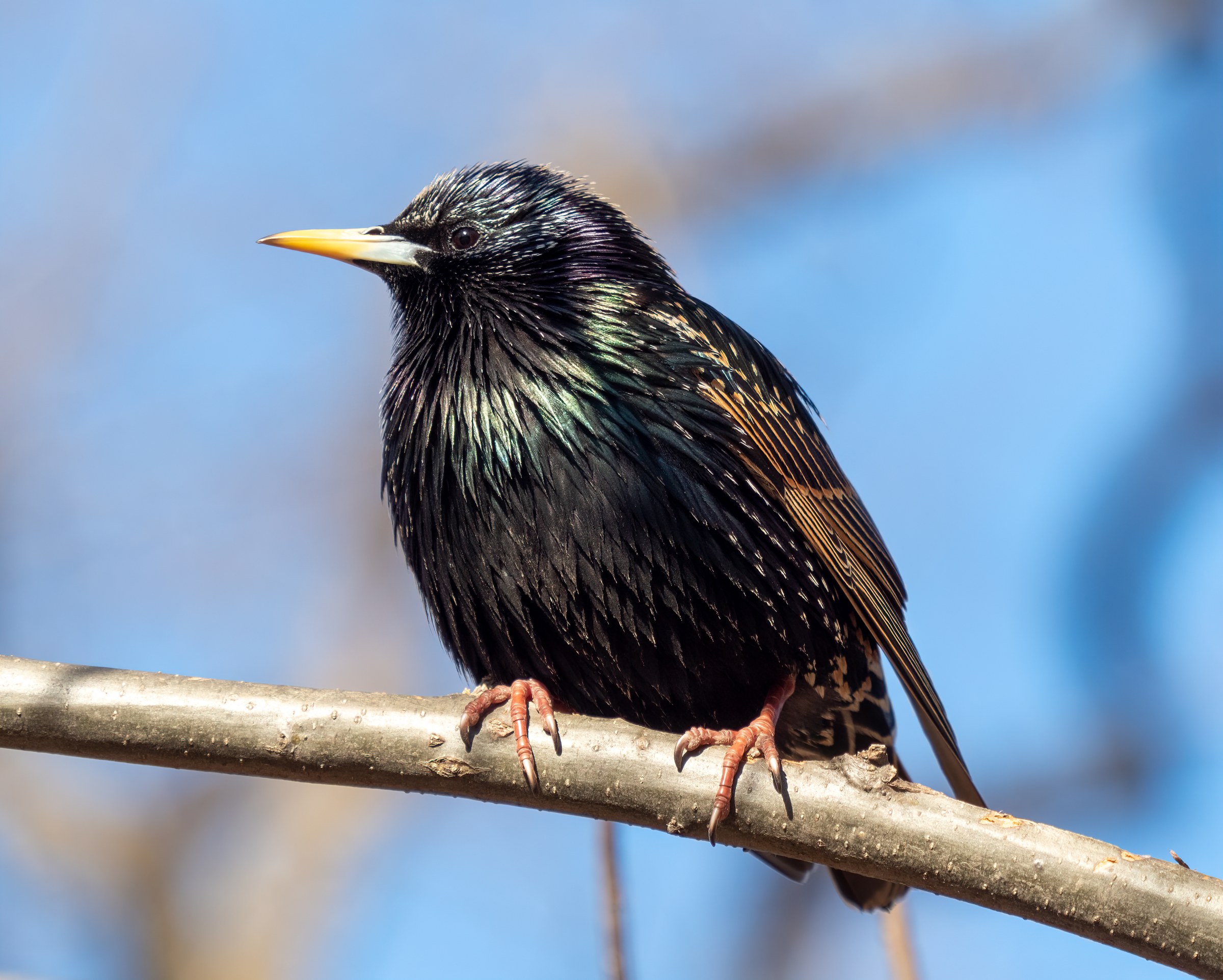
- Color Pattern: In spring and summer, glossy black with purple and green iridescence, a yellow bill, and pinkish legs. In fall and winter, dark plumage heavily spangled with white and buff spots, the bill dark — a complete seasonal costume change without a true molt into different feathers: the pale tips simply wear off by spring.
- Juveniles & Seasons: Young birds are plain gray-brown with a dark bill, following parents across lawns with loud begging calls — the classic early-summer backyard scene before families merge into flocks.
The oil-slick songster: glossy black shot with purple on the head and green on the body, yellow bill, pale eyes catching the light. Males sing from cavities and rooftops with wings drooped and throat feathers fluffed, weaving whistles, rattles, and borrowed phrases from other birds’ songs.
The walking constellation — every fresh feather carries a white or buff tip, so the whole bird looks speckled and dark-billed. Males and females look alike in both seasons; sexing them in the field is essentially impossible without the bird in hand.
European Starling Vocalization Guide (3 Field Recordings)
The European Starling is a world-class mimic: its song stitches together whistles, warbles, rattles, clicks, and borrowed phrases — Killdeer, woodpecker, and even mechanical sounds worked in. The classic call is a descending, drawn-out wheeze. All three recordings below are real field audio, shared under commercial-use licenses via Wikimedia Commons — no simulations. For a deeper library, browse xeno-canto: European Starling.
1. The Mimic’s Song
2. The Rambling Medley
3. The Descending Wheeze
Habitat, Range & the Introduced Conquest
The European Starling is a bird of human-altered landscapes: cities, suburbs, farms, feedlots, lawns, and parking lots. It is scarce in deep forest and true wilderness — which is precisely why it conquered a continent of lawns in barely over a century.

From 100 Birds to a Continent
Every starling in North America descends from roughly 100 birds released in New York’s Central Park in 1890 and 1891 by enthusiasts who wanted America to host every bird in Shakespeare. By the mid-twentieth century the species spanned the continent; today it lives year-round across the United States and southern Canada, with northern populations drifting south in winter.
The same introduction played out in Australia, New Zealand, and South Africa. For backyard birders, the practical reality is simple: if you have a lawn, a suet feeder, or a nest box, you have starlings — the question is only how you manage them.
Backyard Behavioral Patterns & Social Dynamics
The European Starling is a specialist in living alongside us — probing our lawns, nesting in our structures, and mobbing our feeders. Four behaviors explain most of what you will observe:
🌱 The Lawn Prober
Starlings hunt lawn grubs with a technique all their own: open-bill probing — the closed bill is pushed into the turf, then pried open to part the grass and expose beetle larvae and cutworms. A line of speckled birds marching across a mowed lawn, jabbing as they go, is free pest control in action.
🌪 The Murmuration
Winter flocks number in the thousands, and at dusk they gather into wheeling, folding clouds that move like a single organism — each bird tracking its nearest neighbors, the whole mass dodging falcons in waves. A murmuration over a winter roost is one of the continent’s great natural spectacles.
🏠 The Cavity Grabber
Starlings nest in cavities and fight hard for them — evicting bluebirds, tree swallows, and even woodpeckers from nest boxes and natural holes. Pairs start scouting cavities in late winter, stuff them with grass and trash, and can raise two broods a season in a single box.
🧈 The Suet Raider
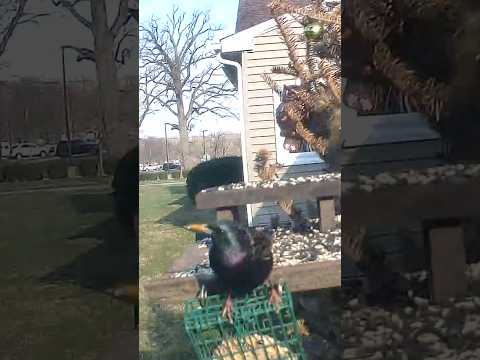
At the feeding station, suet is the target: starlings cling to suet cages and shred a cake in a day, shouldering aside woodpeckers and nuthatches. They will also swarm platform feeders for cracked corn and millet — which is why feeder design, not feeder placement, is the real solution.
Problem: “Starlings Empty My Suet in a Day — and They Took the Bluebird Box. What Should I Do?”
The two most common European Starling problems both have proven, humane answers:
First, the emptied suet: flip the feeder. Upside-down suet feeders force birds to cling underneath, which woodpeckers, chickadees, and nuthatches do easily and starlings do clumsily; cage-enclosed suet and tube feeders with openings under 1.5 inches exclude starlings entirely. Switch seed to safflower and nyjer, which starlings largely ignore, drop cracked corn and millet from the menu, and sweep the spill zone. Second, the seized nest box: starlings cannot fit through a 1.5-inch entrance hole, which is the standard for Eastern Bluebirds — a properly sized box protects itself. Monitor boxes weekly in spring, and remember that European Starlings, as an introduced species, are not protected under the Migratory Bird Treaty Act, so removing starling nests from your own boxes before eggs are laid is generally lawful — unlike interfering with any native bird’s nest. Protect the natives, redesign the buffet, and the starlings will spend their days probing your lawn for grubs instead — a service worth having.
Method 1: Redesign the Buffet — Starling-Resistant Feeding
Feed the natives while making the starlings work for crumbs:
-
Switch Suet to Upside-Down or Caged
Upside-down suet feeders are the single most effective starling defense: woodpeckers and chickadees cling underneath comfortably, while starlings dangle awkwardly and give up. A suet cage inside a wire cage with openings under 1.5 inches is the fortress version for heavy flock pressure.
-
Change the Seed Menu
Safflower and nyjer are the quiet champions — cardinals, finches, and chickadees eat them eagerly while starlings mostly pass. Remove cracked corn, millet, and cheap mixed seed, which are starling magnets, especially when scattered on platforms or the ground.
-
Fortify the Tube Feeders
Cage-enclosed or weight-sensitive tube feeders with short perches admit finches and chickadees while excluding starling-sized birds. Short perches matter: starlings need room to land, and trimming perch length is free.
-
Feed Measured Portions, Clean the Spill
A morning scoop sized to what songbirds eat by noon leaves nothing for an afternoon flock, and a weekly raked spill zone removes the ground buffet starlings prefer. Consistency beats abundance — the natives learn the schedule faster than the flock does.
Method 2: Protect the Natives — Cavity Nester Defense
The real stakes are the nest cavities, not the suet:
-
Size Every Entrance Hole at 1.5 Inches
A 1.5-inch entrance admits bluebirds, chickadees, and tree swallows while physically excluding starlings — the simplest, most effective defense ever devised for a nest box. Check every box you own; enlarge nothing, and add hole restrictors to oversized entrances.
-
Monitor Boxes Weekly in Spring
Starlings scout cavities from late winter onward. A weekly five-minute check catches a starling’s grass-and-trash foundation before eggs appear — and because starlings are introduced and unprotected under the Migratory Bird Treaty Act, removing that early nesting material from your own box is generally lawful. Never disturb a native bird’s nest.
-
Seal Building Cavities
Dryer vents, soffit gaps, and open pipe ends are starling subdivisions. Cap vents with proper covers and seal gaps in fall, after nesting season — an afternoon of hardware cloth and vent caps permanently reduces the local breeding population.
-
Keep the Lawn Working for You
A chemical-free lawn turns starlings into free grub control — their open-bill probing removes beetle larvae and cutworms all season. Accept the patrol, defend the cavities and the suet, and the relationship becomes tolerable, even useful.
Tool Solution: Recommended Hardware for Starling Management
Equipment that feeds the natives and frustrates the flock:
Upside-Down Suet Feeder
A suet feeder that only serves from below — woodpeckers, nuthatches, and chickadees cling and feed comfortably, while starlings flail and abandon it within days.
- • Food: Suet cakes, plugs
- • Style: Bottom-access only
- • Bonus: Deters grackles too
Caged Tube Feeder
A tube feeder inside a wire cage with openings under 1.5 inches — finches, chickadees, and small woodpeckers pass through; starlings and grackles stay outside while the safflower flows.
- • Food: Safflower, sunflower
- • Openings: Under 1.5 in
- • Bonus: Squirrel-resistant
1.5-Inch Entrance Nest Box
A properly sized bluebird or chickadee box with a 1.5-inch entrance hole — admits the natives you want and physically locks starlings out, no monitoring gimmicks required.
- • Entrance: Exactly 1.5 in
- • Residents: Bluebirds, swallows
- • Check: Weekly in spring
Frequently Asked Questions
- Species Profile: The European Starling (Sturnus vulgaris) is a 7.9–9.1 inch, 2.1–3.4 ounce songbird (Sturnidae), band code EUST — an introduced species now numbering in the hundreds of millions in North America.
- ID in One Look: Stocky body, very short squared tail, long pointed bill; glossy purple-green with yellow bill in spring, heavily white-speckled with dark bill in winter; juveniles plain gray-brown.
- The Sound: A rambling mimic’s song of whistles, warbles, rattles, and borrowed phrases, plus the descending tcheeer call of the flock; three real field recordings above.
- Range & Habit: Descended from about 100 birds released in Central Park in 1890–91; now year-round across the U.S. and southern Canada — a bird of lawns, cities, farms, and feeders, famous for winter murmurations.
- Management Formula: Upside-down or caged suet feeders, cage-enclosed tubes, safflower and nyjer instead of corn and millet, measured morning portions, and a raked spill zone.
- Protect the Natives: 1.5-inch entrance holes exclude starlings from bluebird boxes; monitor boxes weekly in spring — starlings are unprotected under the Migratory Bird Treaty Act, so early nest removal from your own boxes is generally lawful.

Bird Watching Log
Species: European Starling (Sturnus vulgaris)
| European Starling (Speckled Plumage: Yes / No — Yellow Bill: Yes / No — Suet Raiding: Yes / No — Flock Size: Small / Large) | |