
Tree Swallow



Tree Swallow (Tachycineta bicolor): Complete Identification, Habitat Guide & Sound Library
Quick Answer: How to Attract & Identify the Tree Swallow
The Tree Swallow (Tachycineta bicolor) is the iridescent blue-and-white swallow of meadows and wetlands — glossy blue-green above, snow-white below, with a tiny bill and a squared tail. It nests in cavities and readily uses nest boxes, lining the cup with feathers. The song is a sweet, liquid twittering. It is the hardiest swallow — able to survive cold snaps on bayberries when insects vanish. Yards attract them with nest boxes near open grass or water. They share the meadow with the Eastern Bluebird and the Barn Swallow.
Species Physical Profile & Morphometrics
The Tree Swallow belongs to the swallow family (Hirundinidae) and breeds across northern North America wherever open country, water, and nesting cavities meet — the continent’s most reliable nest box swallow.
The identification formula: iridescent blue-green back + pure white underparts + squared tail. The Violet-green Swallow shows white wrapping above the eye and white rump patches; the Barn Swallow wears a forked tail and rusty throat. Juveniles are brown above with a faint gray breast band.
Essential Morphometric Field Marks:
- Body Length & Mass: 4.7 to 5.9 inches (12–15 cm) and 0.6 to 0.9 ounces (17–29 grams) — a compact, powerful flier.
- Wingspan: 11.8 to 13.8 inches (30–35 cm); flight is buoyant and acrobatic, hawking insects in loops over grass and water.
- Bill Structure & Color: A tiny black bill with a wide gape — small target, big mouth, the standard swallow design.
- Color Pattern: Iridescent blue-green upperparts, clean white underparts, dark flight feathers — a crisp two-tone with a jewel finish.
- Male vs. Female: He is the brighter, glossier blue; she is duller, sometimes with brown mixed into the back in her first breeding year.
The iridescent sentry: perched on the nest box roof, back flashing green-blue in the sun, singing his liquid twitter at every rival.
Duller blue, sometimes brown-washed — she lines the nest with white feathers and does the incubating while he guards the box.
Tree Swallow Vocalization Guide (3 Field Recordings)
The Tree Swallow’s song is a sweet, liquid twittering — cheerful chirps and trills given from the box or on the wing. All recordings below are real field audio via Wikimedia Commons — no simulations. For a deeper library, browse xeno-canto: Tree Swallow.
1. The Liquid Twitter
2. The Flight Chatter
3. The Defense Rattle
Habitat, Range & the Nest Box Meadow
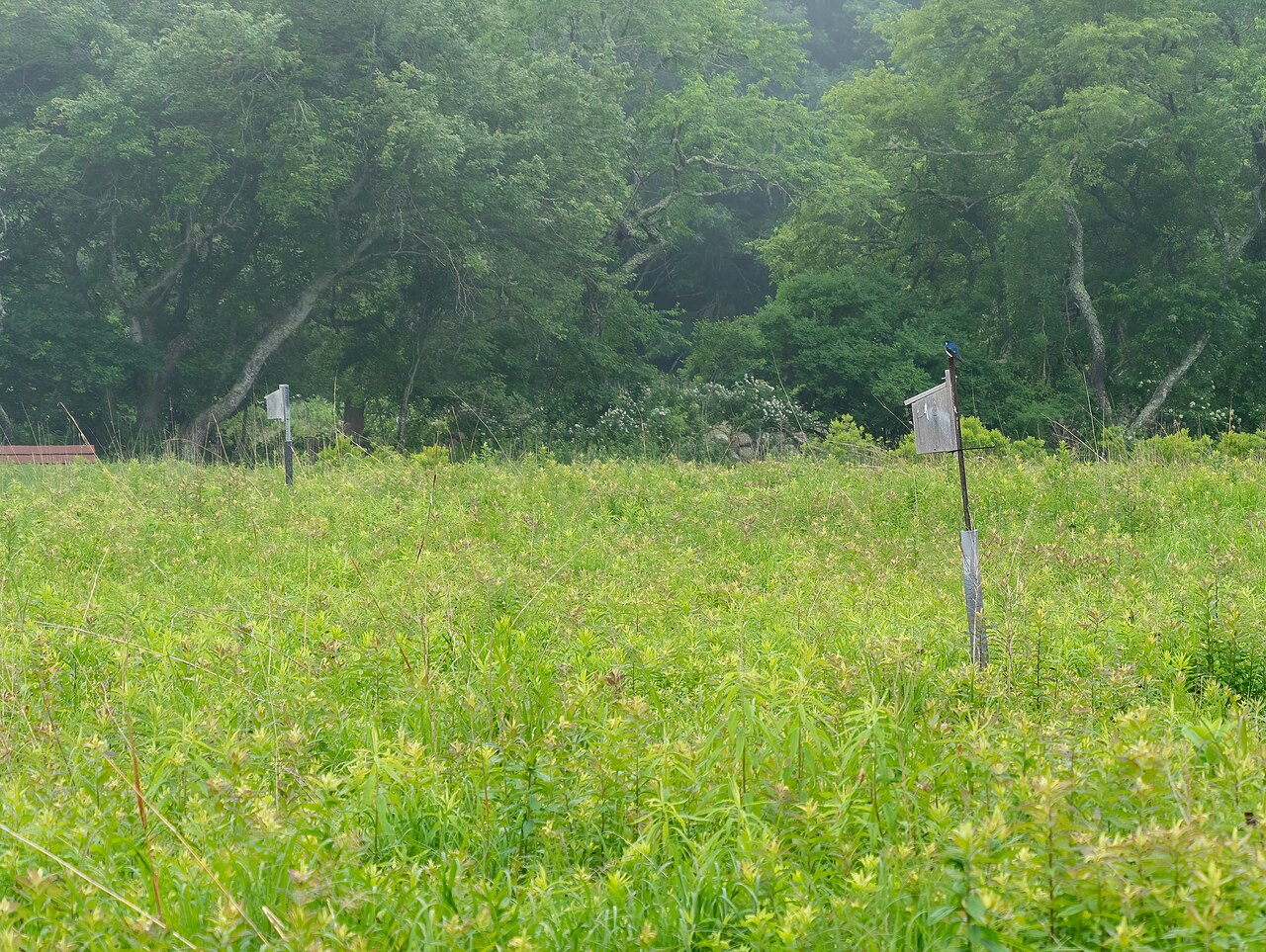
The Tree Swallow lives in open country near water: meadows, marshes, lake edges, and fields — anywhere with flying insects and a cavity within gliding distance. It is the swallow that turned the nest box trail into an institution.

The Bluebird Box’s Other Tenant
Breeding range spans Alaska and Canada south into the northern and central states; in winter the population gathers along the southern Atlantic and Gulf coasts and Mexico, forming enormous bayberry-fed roosts.
For backyard birders: a nest box on a pole near open grass or water is the whole invitation — Tree Swallows compete with bluebirds for boxes, and paired boxes ten feet apart can settle both.
Backyard Behavioral Patterns & Social Dynamics
The Tree Swallow is a cavity-nesting aerialist with a survival trick. Four behaviors explain most of what you will observe:
🏠 The Box Tenant
It nests in cavities and nest boxes — old woodpecker holes, bluebird boxes, martin houses — defending the entrance fiercely.
🪶 The Feather Cup
The nest is lined with white feathers — an insulating signature so consistent it identifies the owner at a glance.
🫐 The Bayberry Backup
When cold snaps ground the insects, it survives on bayberries and wax myrtle — a fruit fallback unique among swallows.
🎯 The Meadow Hawk
It feeds on the wing low over grass and water — beetles, flies, and dragonflies taken in looping pursuit.
Problem: “How Do I Host Tree Swallows and Bluebirds Together? What Should I Do?”
The three most common Tree Swallow puzzles all have proven answers:
First, the box war: swallows and bluebirds fight over single boxes — the proven fix is paired boxes 10–15 feet apart; a swallow pair will defend its own box and leave the neighbor to bluebirds. Second, the sparrow invasion: House Sparrows kill nestlings — remove sparrow nests immediately and legally (an unprotected introduced species) and keep boxes on poles with guards. Third, the cold-snap crash: spring freezes ground the insects — swallows survive by switching to bayberries; do not assume a silent box is abandoned, check again after the warm-up.
Method 1: Set the Table — Nest Boxes Done Right
Design for a cavity-nesting meadow swallow:
-
Mount Boxes on Poles
1.5-inch entrance, 5–6 feet high, predator guard below — the standard swallow-bluebird box configuration.
-
Pair Your Boxes
Two boxes 10–15 feet apart — one for swallows, one for bluebirds, peace through proximity.
-
Face Boxes to Open Grass
Entrance facing meadow or water — swallows hunt the open lanes and want the runway clear.
-
Monitor Weekly
Check without touching during nesting — evict House Sparrow nests promptly; they are unprotected and deadly.
Method 2: Build the Habitat — Open Hunting Grounds
Keep the insects flying and the lanes open, and the pair claims a box each spring:
-
Keep Open Meadows
Unmowed grass and field margins — the flying-insect farm a swallow family needs.
-
Protect Wetland Edges
Marshes and pond margins concentrate midges — the densest swallow foraging in the neighborhood.
-
Skip the Insecticide
Sprayed lawns are empty skies — the whole diet is on the wing.
-
Plant Bayberry
Northern bayberry and wax myrtle shrubs — the emergency rations that carry swallows through cold snaps.
Tool Solution: Recommended Hardware for Tree Swallow
Equipment matched to a box-nesting meadow swallow:
Swallow-Bluebird Nest Box
A 1.5-inch-entrance box on a pole with a predator guard — the proven Tree Swallow homestead.
- • Entrance: 1.5 inches
- • Height: 5–6 feet
- • Spacing: Pair 10–15 feet
Open Meadow or Pond Edge
Grass and water margins — the airspace where the whole menu flies.
- • Feature: Open + wet
- • Rule: No insecticide
- • Bonus: Martins & bats too
Bayberry & Wax Myrtle
Native fruiting shrubs — the cold-snap survival ration no other swallow can use.
- • Plants: Native bayberry
- • Zones: Coastal & northern
- • Bonus: Yellow-rumped warblers
Frequently Asked Questions
- Species Profile: The Tree Swallow (Tachycineta bicolor) is a 4.7–5.9 inch, 0.6–0.9 ounce swallow (Hirundinidae), band code TRES — the blue-and-white box nester.
- ID in One Look: Iridescent blue-green back, snow-white breast, squared tail.
- The Sound: Sweet liquid twitter at the box; hard rattle in defense; real field recordings above.
- Range & Habit: Northern breeder, southern coastal winterer; nests in cavities and boxes; eats bayberries in a pinch.
- Feeder Formula: A pole-mounted box over open grass — seed is irrelevant to an aerial hunter.
- The Pairing Trick: Two boxes ten feet apart ends the swallow-bluebird war.
Bird Watching Log
Species: Tree Swallow (Tachycineta bicolor)
| Tree Swallow (Blue Back Seen: Yes / No — Box Claimed: Yes / No — Twitter Heard: Yes / No — Feather Lining Seen: Yes / No — Date & Time: ___) | |