
Pygmy Nuthatch


Pygmy Nuthatch (Sitta pygmaea): Complete Identification, Feeder Guide & Call Library
Quick Answer: How to Attract & Identify Pygmy Nuthatches
The Pygmy Nuthatch (Sitta pygmaea) is the smallest nuthatch in North America and the most social — a 3.5–4.3-inch, 9–11-gram climber in blue-gray and buffy white with a warm gray-brown cap and a pale spot on the nape. A member of the nuthatch family (Sittidae), it forages acrobatically through the pine canopy — often upside down — in noisy, chattering flocks, and it is a famous communal rooster: more than 100 birds have been found huddled in a single tree cavity on cold nights. It is a year-round resident of western pine forests, especially ponderosa, from southern British Columbia to central Mexico, a cooperative breeder with helper birds at the nest, and a ready user of nest boxes. Attract a flock with suet, sunflower hearts, crushed peanuts, water, and mature pines with a dead stub or two.
Species Physical Profile & Morphometrics
The Pygmy Nuthatch is the western counterpart of the southeastern Brown-headed Nuthatch — the two are so alike that the surest separator is a map. Within its range, it is the smallest nuthatch by a clear margin, and the one most often seen in the treetop foliage rather than creeping along trunks like its bigger cousins, the White-breasted and Red-breasted Nuthatches.
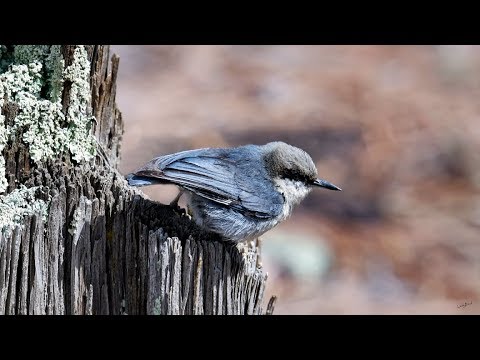
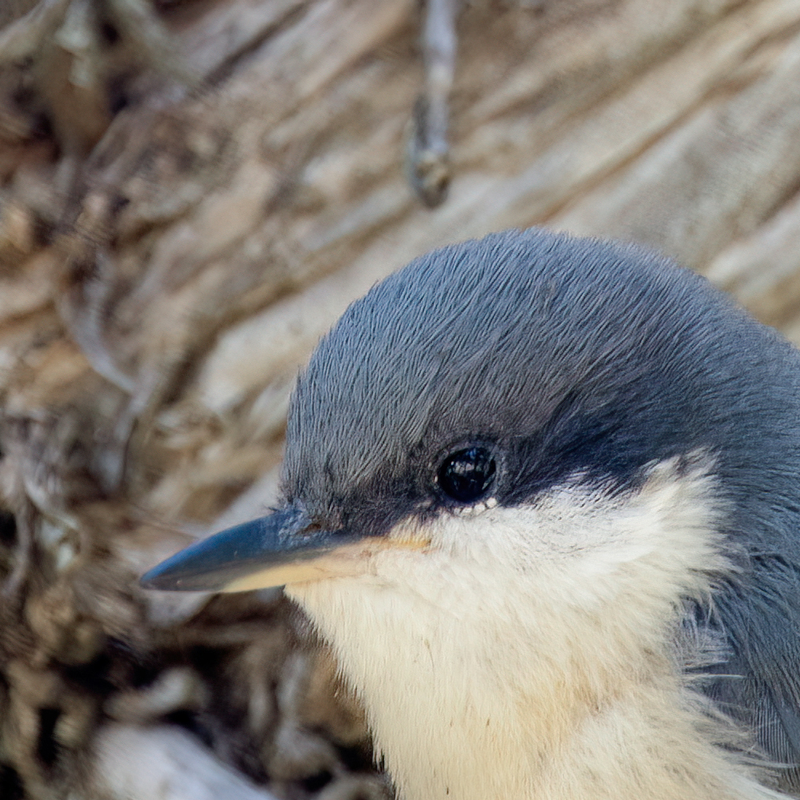
The silhouette gives it away first: a big, rounded head with no visible neck, a short, square tail, and a straight, sharp bill. The gray-brown cap ends in a crisp dark line through the eye; the back and wings are blue-gray; the underparts run whitish to pale buff. A whitish spot on the nape shows especially in worn summer plumage, and in flight the tail flashes a white band near the tip. Sexes look alike.
Essential Morphometric Field Marks:
- Body Length & Mass: Averages 3.5 to 4.3 inches (9–11 cm) and just 0.33 to 0.4 ounces (9.3–11.4 grams) — the smallest of the four North American nuthatches.
- Wingspan: About 7.8 inches (19.7 cm), with short, broad wings built for quick dashes between trees.
- Bill Structure & Color: A straight, sharp, chisel-like dark bill — a prying and gleaning tool sized for pine-needle clusters and bark crevices.
- Color Pattern: Warm gray-brown cap to the eye, blue-gray upperparts, whitish to buffy underparts, pale nape spot, white subterminal tail band. All plumages are similar year-round.
The two “brown-capped” nuthatches meet almost nowhere: Pygmy is the western mountain bird, Brown-headed the southeastern one. Up close, the Pygmy’s cap is duller gray-brown and its call a rapid “pip-pip” rather than a rubber-duck squeak.
If a nuthatch in the western pines arrives with a dozen chattering companions, think Pygmy first. No other North American nuthatch travels, bathes, and even sleeps in such tight-knit groups.
Pygmy Nuthatch Vocalization Guide (3 Acoustic Simulations)
The Pygmy Nuthatch has no true song — instead, flock members keep up a constant, high-pitched commentary of chirps and peeps: rapid “pip pip” notes and excited “tee-dee-dee” twittering that lets the whole group stay in contact as it flows through the canopy. Honest note: no openly licensed field recording of this species is currently available in the Wikimedia audio commons, so all three cards below are clearly labeled acoustic simulations built to published descriptions of the calls. For real wild audio, browse xeno-canto: Pygmy Nuthatch.
1. The Contact Call — “Pip Pip”
2. Flock Chatter — “Tee-Dee-Dee”
3. Soft Pair Notes
Habitat, Range & Year-Round Resident Biology
Pygmy Nuthatches are birds of western pine forest — above all ponderosa pine, plus Douglas-fir and other conifers — from southern British Columbia south through discontinuous mountain forests of the Pacific Northwest, the Sierra Nevada, the Great Basin ranges, and the Rockies, all the way to the highlands of central Mexico. They are birds of the middle and upper elevations, and they do not migrate: outside the breeding season the flocks simply wander their home woods, sometimes drifting downslope in hard weather.

The Vanilla-Scented Forest
Ask a ranger where to look and you will get a sniff test: mature ponderosa bark smells of vanilla, and where those big orange-plated trunks stand, Pygmy Nuthatches usually are too — probing the crevices and needle clusters in small, noisy parties.
Old, open-grown pine forest is ideal, because the birds need dead stubs for nest cavities right beside live pines for food. In winter they commonly travel in mixed flocks with Mountain Chickadees and kinglets, so a yard that draws the flock draws the whole neighborhood.
Backyard Behavioral Patterns & Social Dynamics
This is the most social songbird in the western woods. Four signature behaviors explain most of what you will observe:
🐦 The Noisy Flock
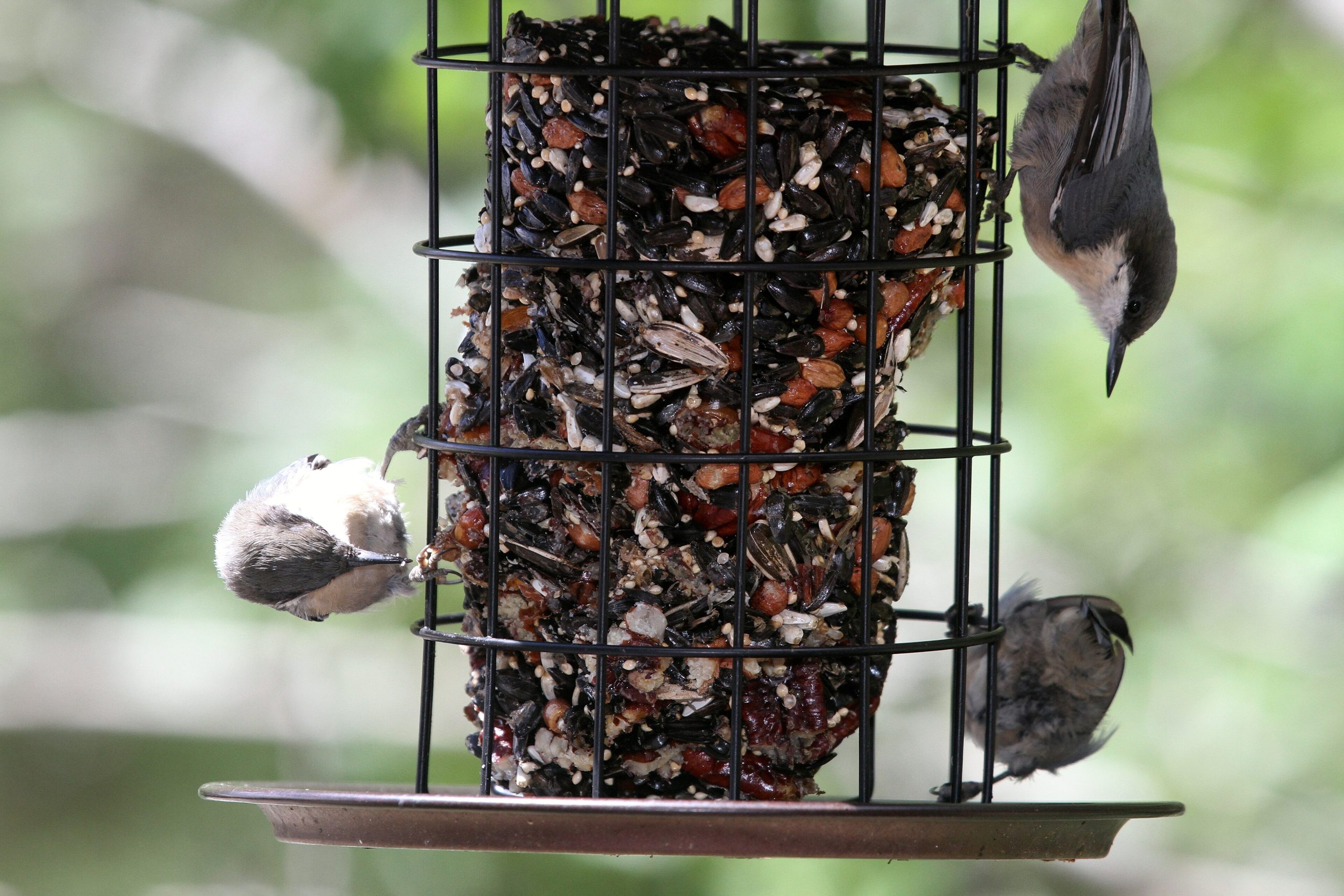
One Pygmy Nuthatch means ten more are coming. Families merge into loose flocks of dozens that tumble through the pines in a rolling wave, chirping constantly — exactly the scene on the feeder in our opening photo.
🛖 The Hundred-Bird Bedroom
On cold nights the flock roosts communally in a tree cavity — more than 100 birds have been found huddled in a single hole, stacked like firewood to share warmth. Uncleaned nest boxes get used the same way.
🧗 Acrobat of the Pine Tips
Unlike bigger nuthatches, this species does much of its foraging acrobatically among the needle clusters, hanging upside down to pick insects and seeds — though it still walks trunks headfirst when the mood takes it.
🪶 The Fur-Lined Doorway
Nest cavities in dead stubs are lined with pine-cone scales and soft plant fibers, and the birds often pack fur into the cracks around the entrance — a door-sealing habit whose purpose still puzzles ornithologists. Grown sons commonly stay home as nest helpers.
Problem: Why Pygmy Nuthatches Stay Up in the Treetops
Across the piney West the usual report runs: “I hear them chattering overhead all day, but they never come down to my feeders.” The reasons are predictable:
First, this is a canopy forager: most of its food is taken high among the needles, so a feeder has to be worth the trip down — plain mixed seed on an open lawn rarely is. Second, the menu is wrong: a 10-gram bird with a fine bill wants suet, sunflower hearts, and crushed nuts, not big striped sunflower or millet. Third, the flock needs a reason to land together: a single small port feeds one bird and sends the rest back to the treetops, while a suet cage and platform near the pines let the whole party feed at once. Hang the right food at the forest edge — and add water — and the chatter overhead turns into birds at the window.
Method 1: Set the Table — Suet, Crushed Nuts & Water
Design for a tiny, social, canopy-feeding acrobat:
-
Hang a Suet Cage at the Forest Edge
A wire suet cage is the top Pygmy Nuthatch feeder — every face is clingable, so the flock can pile on together, just like our gallery photo. Mount it on or beside a pine trunk. Our lab-tested roundup of the Best Suet Feeders & Cakes compares proven models.
-
Think Small & Soft: Hearts and Crushed Nuts
Stock sunflower hearts or chips and finely crushed unsalted peanuts — bite sizes a fine-billed 10-gram bird can actually handle. Skip whole large seeds; the flock will sample once and write you off.
-
Keep Feeders a Short Dart from the Pines
Place the station within a few wing-beats of mature pine trunks. The flock stages in the canopy, pours down to feed, and pours back — a feeder stranded on open lawn sits ignored.
-
Add Moving Water
A shallow bath with a dripper is a flock magnet, above all in the dry interior West — our bathing photo shows how readily they commit. In freezing snaps, a heated bird bath keeps the station open when every natural source locks up.
Method 2: Keep Them Year-Round — Pines, Snags & Nest Boxes
Turn a passing flock into permanent, breeding neighbors:
-
Protect the Big Pines — and One Dead Stub
Live pines feed them; dead conifer stubs house them. If a dead trunk stands well away from the house and foot traffic, leave it — that soft, rotting wood is next spring’s nest cavity and next winter’s communal roost.
-
Hang a Nest Box — Maybe Two
Pygmy Nuthatches take readily to nest boxes with a 1-1/4-inch entrance hole, mounted 8–15 feet up near pines. Given the communal-roosting habit, an extra box or two left up year-round gives the flock winter bedrooms. See our Best Nest Boxes for Small Birds.
-
Offer Fur, Hair & Soft Fibers
The birds line the cavity with pine-cone scales and plant down and famously pack fur around the entrance cracks. A mesh basket of pet fur and natural fiber hung in spring is genuinely useful raw material.
-
Feed Through Every Season
They never migrate — the flock mobbing your suet in a January storm is the same one raising young nearby in May, often with helper sons in tow. Year-round reliability is what turns a flyover flock into yard residents.
Tool Solution: Recommended Hardware for Pygmy Nuthatches
Equipment matched to a tiny, flocking, fine-billed acrobat:
Hanging Suet Cage
The classic wire cage a whole flock can cling to at once — hung beside a pine trunk, it becomes the group’s daily station.
- • Cake: Nut or insect blend
- • Access: Clingable on all sides
- • Mount: Beside a mature pine
Platform Feeder + Crushed Nuts
A platform feeder stocked with sunflower hearts and finely crushed unsalted peanuts — sized for a 10-gram bird, open enough for the whole flock.
- • Seeds: Sunflower hearts/chips
- • Nuts: Crushed fine, unsalted
- • Placement: Short dart from pines
Small-Entrance Nest Boxes
A box with a 1-1/4-inch entrance, mounted 8–15 feet up near pines — used for nesting in spring and as a communal roost in winter, so leave it up year-round.
- • Entrance: 1-1/4 in
- • Mount: 8–15 ft, near pines
- • Bonus: Winter roost for the flock
Frequently Asked Questions
- Species Profile: The Pygmy Nuthatch (Sitta pygmaea) is the smallest North American nuthatch — 3.5–4.3 inches, 9.3–11.4 grams — with a gray-brown cap, blue-gray back, buffy underparts, a pale nape spot, and a short square tail.
- Western Pine Resident: Non-migratory in ponderosa and mixed conifer forest from southern British Columbia through the Sierra Nevada and Rockies to central Mexico.
- Most Social Nuthatch: Travels in noisy chattering flocks, breeds with grown sons as nest helpers, and roosts communally — more than 100 birds have been found packed into a single tree cavity.
- The Voice: No true song — instead a constant stream of high “pip pip” contact notes and excited “tee-dee-dee” twittering that reveals the flock overhead.
- Feeder Formula: A suet cage hung by a pine trunk, sunflower hearts, and crushed peanuts — plus a shallow or heated bath, a top draw in the dry West.
- Nesting Help: Protect dead stubs, hang nest boxes with a 1-1/4-inch entrance 8–15 feet up, and offer pet fur in spring — the birds pack it around the nest entrance.
Bird Watching Log
Species: Pygmy Nuthatch (Sitta pygmaea)
| Pygmy Nuthatch (Flock Size / Nape Spot Seen?: ____________________________) | |