
Zebra Dove
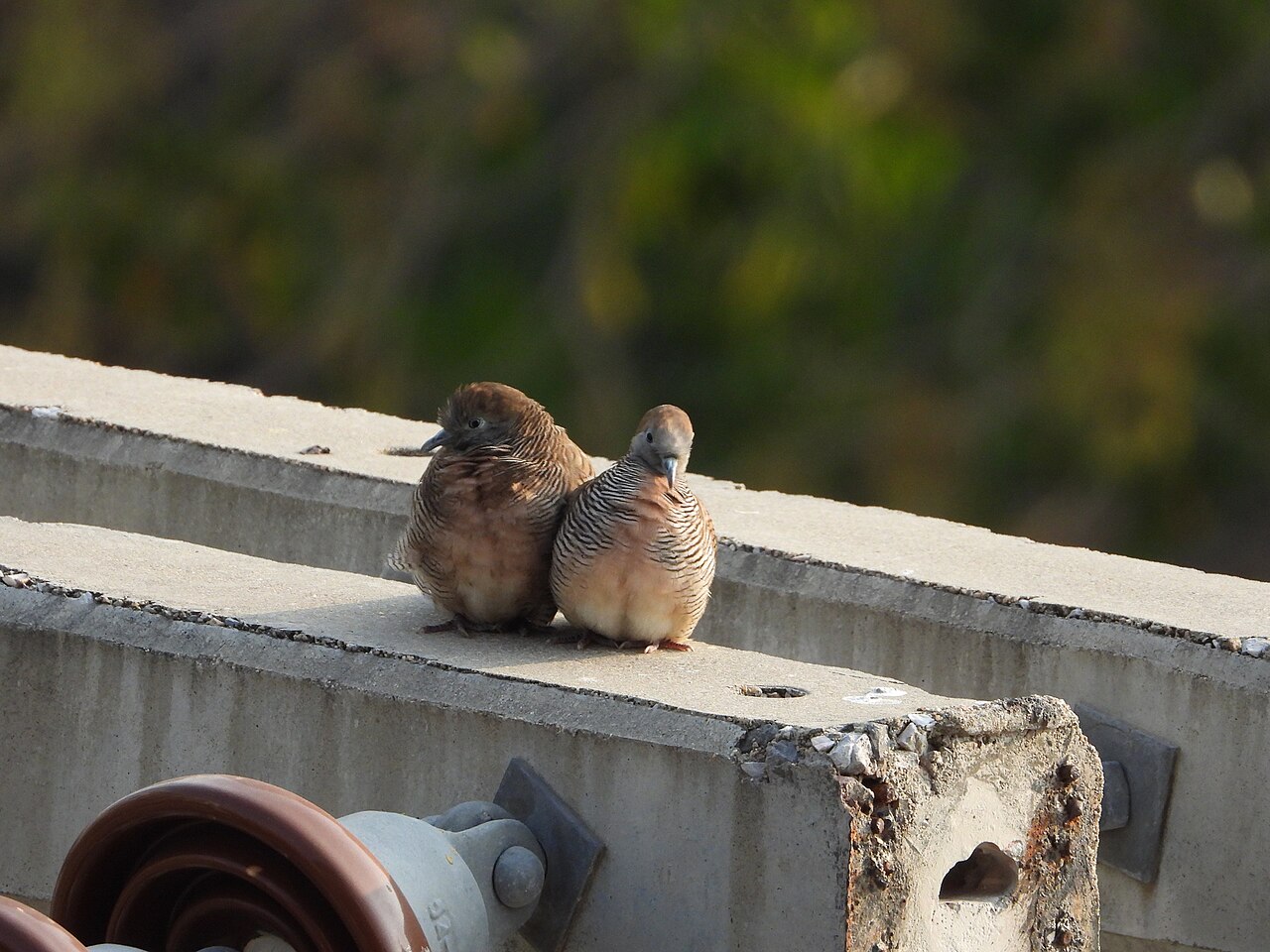


Zebra Dove (Geopelia striata): Complete Identification, Habitat Guide & Sound Library
Quick Answer: How to Attract & Identify the Zebra Dove
The Zebra Dove (Geopelia striata) is the small striped dove of Hawaiian gardens — a gentle Southeast Asian import, established in Hawaii since 1922, with a finely barred neck and breast, a soft pink wash, and blue-gray skin around the eye. Its voice is a soft, rapid cooing — one of the everyday sounds of the islands. It feeds on tiny seeds picked from lawns and paths. Hawaiian yards attract them with scattered millet on open ground, a shallow water dish, and low shrub cover. They share the lawn with the Spotted Dove and the Common Myna.
Species Physical Profile & Morphometrics
The Zebra Dove belongs to the pigeon and dove family (Columbidae) — a native of Southeast Asia introduced to Hawaii in 1922 and now abundant on all the main islands, from beach parks to mountain gardens.
The identification formula: small dove + finely barred neck and breast + blue-gray eye skin. The Spotted Dove is much larger with a black-and-white checkered neck patch; the Zebra Dove is petite and striped all over. The soft stuttering coo is the sound of every Hawaiian morning.
Essential Morphometric Field Marks:
- Body Length & Mass: 7.9 to 8.7 inches (20–22 cm) and 1.4 to 2.1 ounces (40–60 grams) — Hawaii’s smallest common dove, half the bulk of a Spotted Dove.
- Wingspan: Wings are small and rounded, built for short dashes from lawn to shrub — not for distance.
- Bill Structure & Color: A small, delicate dark bill for picking tiny grass and weed seeds off bare ground.
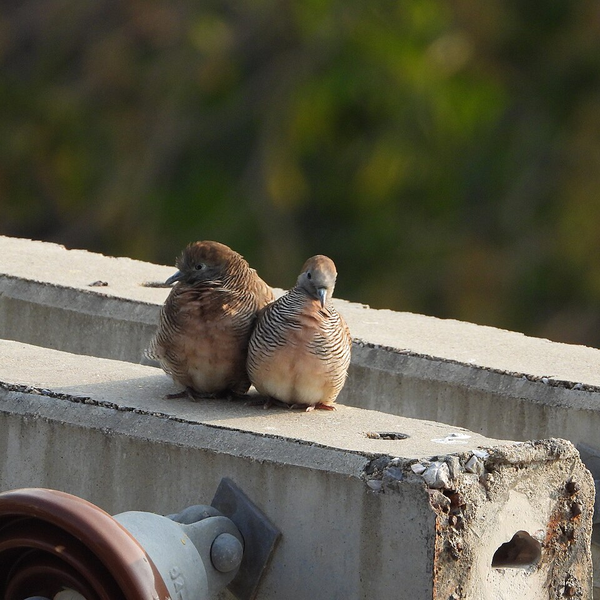
- Color Pattern: Fine black-and-white barring over the neck, breast, and shoulders; pinkish wash on the breast; blue-gray bare skin around the eye; tail tipped white.
- Male vs. Female: Sexes look alike; males average slightly pinker on the breast and do most of the advertising cooing from a perch.
The gentle cooer: striped and pink-breasted, perched on the lanai rail delivering his soft stuttering song, then fluttering down to feed at his mate’s side.
The near-identical partner — same stripes in a slightly duller tone — she lays two white eggs in a flimsy twig platform in a garden shrub and shares incubation duty through the warm days.
Zebra Dove Vocalization Guide (3 Field Recordings)
The Zebra Dove’s song is a soft, rapid, stuttering coo — coo-coo-coo-coo in quick series — one of the signature background sounds of the Hawaiian Islands. All recordings below are real field audio via Wikimedia Commons — no simulations. For a deeper library, browse xeno-canto: Zebra Dove.
1. The Stuttering Coo
2. The Pair Duet
3. The Flutter Whistle
Habitat, Range & the Island Garden
In Hawaii the Zebra Dove lives wherever people do: gardens, lawns, parks, resort grounds, farm edges, and roadsides from sea level to mountain towns. It needs open ground to feed, shrubs to nest in, and water to drink — the everyday Hawaiian yard supplies all three.

The Islands’ Everyday Dove
Introduced from Southeast Asia in 1922, the Zebra Dove is now abundant on every main Hawaiian island — Oahu, Maui, Hawaii, Kauai, Molokai, and Lanai — one of the most familiar birds in the state.
For island yards: if you have a lawn and a shrub, you already qualify — a daily scatter of millet and a shallow water dish will have a pair adopting your garden within the week.
Backyard Behavioral Patterns & Social Dynamics
The Zebra Dove is a tame ground-feeding garden dove whose life runs on seed, sun, and a mate. Four behaviors explain most of what you will observe:
🌱 The Tiny-Seed Specialist
It feeds on very small grass and weed seeds picked from bare ground and lawn edges — a niche that keeps it out of competition with larger doves.
💑 The Faithful Pair
Pairs stay together year-round, feeding side by side, preening each other, and sharing incubation — garden romance on a daily schedule.
☀️ The Sunbather
On warm mornings they sprawl on paths with wings spread, sunning — a normal dove behavior that controls feather parasites.
🏡 The Lanai Tame
Around quiet households they become remarkably confiding, feeding within arm’s reach of a still observer — Hawaii’s gentlest yard companion.
Problem: “My Yard Has Two Kinds of Doves. How Do I Tell Them Apart?”
The three most common Zebra Dove puzzles all have proven answers:
First, the two-dove question: Hawaiian lawns usually hold both Zebra and Spotted Doves — size and neck pattern settle it: the Zebra is small and striped all over the breast; the Spotted is big with a black-and-white checkered patch on the back of the neck. Second, the disappearing pair: doves vanish when cats or mongoose work the lawn — feed only where a shrub sits within a short dash, and the pair returns. Third, the non-cooing mystery: if your doves are silent, they may be nesting nearby — pairs go quiet around the flimsy twig nest in the shrub; listen again a week after the eggs hatch.
Method 1: Set the Garden Table — Millet & Shallow Water
Design for a small ground-feeding dove:
-
Scatter Millet on Open Ground
White millet on a lawn edge or bare patch, refreshed daily at the same hour — the Zebra Dove’s perfect table.
-
Provide a Shallow Water Dish
A low dish with an inch of fresh water — doves drink by suction and visit morning and evening.
-
Feed Beside Escape Cover
Keep every feeding spot within a short dash of a shrub or hedge — ground birds feed where they can flee.
-
Keep a Sunny Dust Patch
A bare sunny patch of fine soil serves for dust bathing and sunning — the dove spa completes the garden.
Method 2: Protect the Ground Birds — Cats, Mongoose & Quiet
Safety is the whole game for tame ground feeders:
-
Keep Cats Indoors
A ground-feeding dove is helpless against a cat — indoor cats are the covenant of a dove garden.
-
Watch for Mongoose
On islands with mongoose, feed close to cover and elevated near the house — open-lawn feeding far from shelter costs birds.
-
Offer a Nesting Shrub
A dense garden shrub or small tree holds the flimsy twig nest — leave it untrimmed through the breeding months.
-
Feed at Quiet Hours
Refresh seed early morning, before foot traffic — doves learn the schedule and arrive on it.
Tool Solution: Recommended Hardware for Zebra Dove
Equipment matched to a small island dove:
Millet Scatter at the Lawn Edge
A daily handful of white millet beside the shrub line — the simple station that adopts you into a pair’s territory.
- • Food: White millet
- • Style: Ground scatter
- • Timing: Same hour daily
Shallow Ground Water Dish
A low pan of fresh water near the feeding patch — doves bathe and drink at ground level, morning and evening.
- • Depth: 1 inch
- • Refresh: Daily
- • Bonus: Mynas & cardinals too
Dense Garden Shrub
An untrimmed shrub within a dash of the feeding patch — escape cover by day and a nest site in season.
- • Structure: Dense branching
- • Location: Beside feeding spot
- • Bonus: Nesting platform
Frequently Asked Questions
- Species Profile: The Zebra Dove (Geopelia striata) is a 7.9–8.7 inch, 1.4–2.1 ounce dove (Columbidae), band code ZEBD — the striped garden dove of Hawaii.
- ID in One Look: Small dove with all-over fine barring, pinkish breast, blue-gray eye skin.
- The Sound: A soft stuttering coo — Hawaii’s morning background music; real field recordings above.
- Range & Habit: Introduced in 1922, now on every main island; a tame ground feeder of lawns and gardens.
- Garden Formula: Millet on open ground, a shallow water dish, shrubs within a dash, cats indoors.
- The Gentle Neighbor: Hawaii’s tamest yard bird — quiet, faithful in pairs, and lovely at arm’s length.
Bird Watching Log
Species: Zebra Dove (Geopelia striata)
| Zebra Dove (Pair or Single: Pair / Single — Cooing Heard: Yes / No — At Seed: Yes / No — At Water: Yes / No — Date & Time: ___) | |