
Western Screech-Owl


Western Screech-Owl (Megascops kennicottii): Complete Identification, Nest Box Setup & Call Library
Quick Answer: How to Attract & Identify Western Screech-Owls
The Western Screech-Owl (Megascops kennicottii) is the robin-sized owl of western yards — a stocky little night hunter with ear tufts, yellow eyes, a dark bill, and gray-brown bark-pattern plumage (no red morph in this species). You will hear it before you see it: a series of short hoots that speed up like a bouncing ping-pong ball, or a soft double trill after dark. Despite the name, it almost never screeches. Attract a pair with a wooden owl box mounted 10–30 feet up a tree, a ground-level water dish, standing snags, and a pesticide-free yard full of moths and mice. East of the Rockies, its twin is the Eastern Screech-Owl, separated easily by voice.
Species Physical Profile & Morphometrics
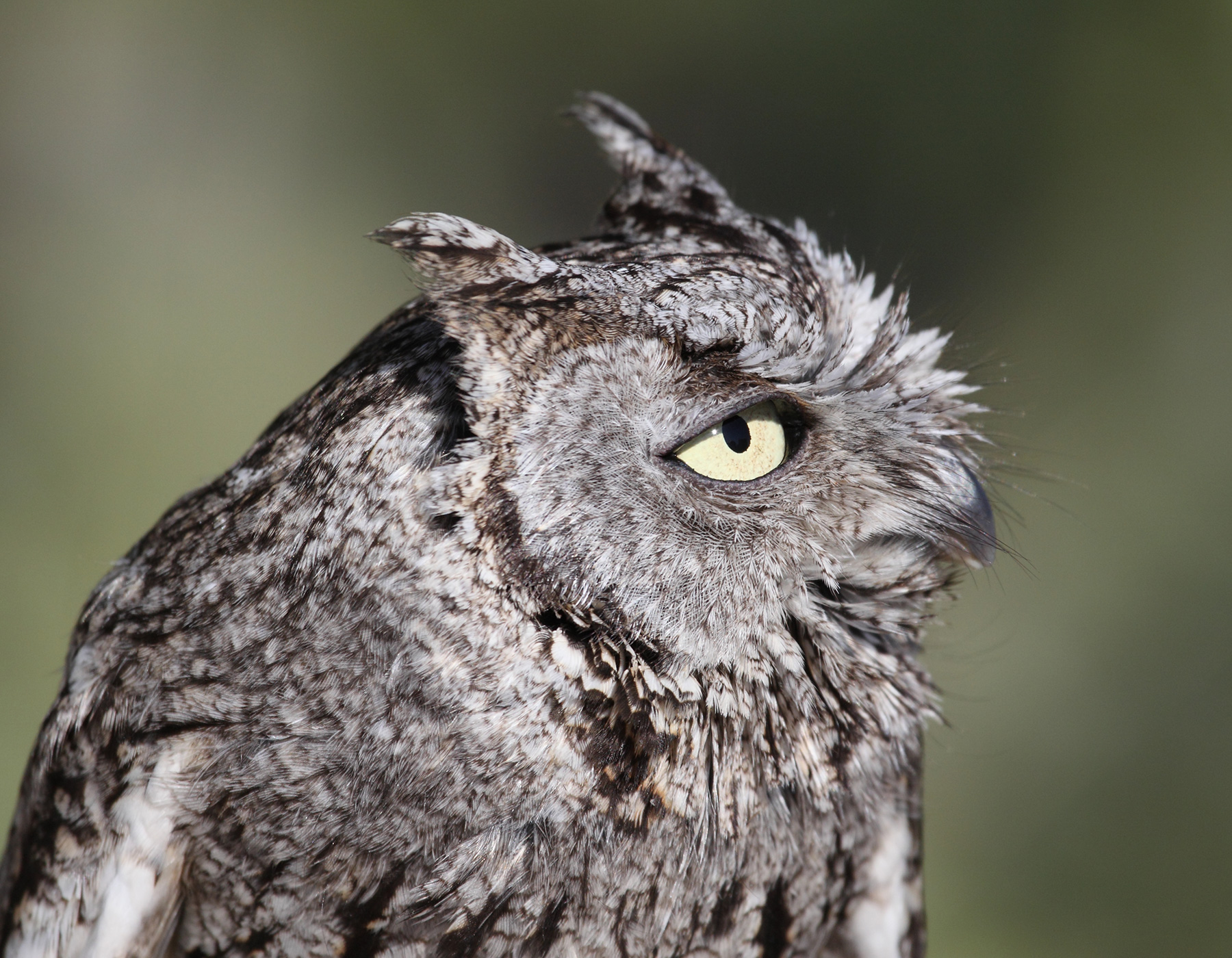
The Western Screech-Owl belongs to the typical owl family (Strigidae) and is built like a miniature great horned owl: stocky body, big rounded head, ear tufts that raise when the bird is alert, and plumage patterned like tree bark in extraordinary detail.
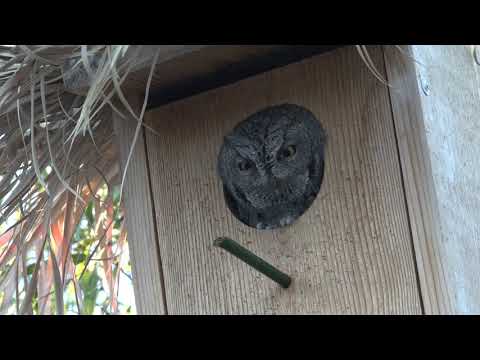
The identification formula: robin-sized + ear tufts + yellow eyes + dark bill + gray-brown bark-mimic plumage + cavity roosting + bouncing-ball song at night. The classic daytime view is a sleepy face filling an old woodpecker hole — or the entrance of a backyard owl box.
Essential Morphometric Field Marks:
- Body Length & Mass: 7.5 to 9.8 inches (19–25 cm) and 3.2 to 11.1 ounces (90–316 grams) — about robin-length but twice as thick, with females averaging larger than males.
- Wingspan: 21.6 to 24.4 inches (55–62 cm); wings are broad and rounded for silent, maneuverable flight between trees — hunting is a short, soundless drop from a low perch, not a long chase.
- Bill & Face: A dark gray to black hooked bill (the Eastern Screech-Owl’s is yellowish-green — the quickest clue where the two nearly meet), pale yellow eyes, and a facial disk that funnels sound to asymmetric ears — this owl can strike prey it cannot see.
- Color Pattern: Gray-brown only — no red morph exists in this species — overlaid with complex streaks and bars that mimic bark. Tones vary subtly by region: grayer in the dry interior, browner along the humid Pacific slope.
- Juveniles: Recently fledged owlets are fluffy gray-white with shorter tufts and perch in tight sibling rows on branches near the nest cavity through early summer.
One plumage, no red phase. Unlike its eastern cousin, this species never comes in a rufous morph — every bird wears fine dark streaking over a bark-gray base. At a cavity mouth at midday it reads as a knot in the wood, not a bird.
Nearly identical to the Eastern Screech-Owl — separated by range (west of the Rockies), voice (bouncing-ball series vs. descending whinny), and bill color (dark vs. yellow-green). In the Great Plains contact zone, voice decides.
Western Screech-Owl Vocalization Guide (3 Field Recordings)
Two calls matter: the accelerating bouncing-ball song and the double trill. All three recordings below are real field audio shared under free licenses — no simulations. For a deeper library, browse xeno-canto: Western Screech-Owl.
1. The Bouncing-Ball Song
2. The Double Trill
3. Night Backyard Session
Habitat, Range & the Backyard Life
The Western Screech-Owl lives west of the Rockies wherever trees and cavities exist — Pacific coast neighborhoods, mountain forests, desert river corridors lined with cottonwoods, and crucially mature suburban yards, where it is often the most common owl nobody knows they have.

The Western Night Shift
This owl is a year-round resident — no migration, ever — so the bird calling over your yard in December is the same one that nested there in April. Home ranges are small; a good territory is a few acres of trees with cavities.
The two requirements are cavities for roosting and nesting — old woodpecker holes, natural hollows, even saguaro boots in the desert Southwest — and nighttime prey: moths, beetles, earthworms, mice. Suburbs supply both, which is why removing every dead limb and spraying every bug is the surest way to lose your local owls.
Backyard Behavioral Patterns & Social Dynamics
Four behaviors define living alongside this owl:
🕳️ The Cavity Face
By day the owl roosts inside a cavity, head filling the entrance, eyes half-mast. Once you find a roost hole — often an old flicker or pileated woodpecker excavation — it may be used for years. Scan holes at midday; the face looking back is unmistakable.
🦋 The Moth Hunter
On summer nights, screech-owls work the moths drawn to porch lights and garden blooms, snatching them off walls and out of the air. A yard with night-flying insects is a stocked pantry — one reason un-sprayed gardens hold more owls.
📦 The Box Adopter
Screech-owls accept wooden nest boxes readily — for roosting year-round and nesting in spring — often within the first season. A box that draws an owl is a decades-long relationship: pairs are sedentary and return to successful sites.
🌳 The Bark Ghost
Threatened at a roost, the owl does not flee — it stretches tall, narrows its eyes, and becomes bark. The camouflage is so complete that songbirds mobbing a roosting owl are often the only clue it exists. Follow the scolding chickadees; they will show you the owl.
Problem: “I Hear a String of Hoots That Speed Up Like a Ping-Pong Ball at Night — What Is It?”
Relax — it is not a pigeon, a gadget, or a threat of any kind. It is a Western Screech-Owl, and it means your yard is healthier than you thought:
The accelerating bouncing-ball song puzzles people out of all proportion to its maker: an owl of a few ounces that spends its nights eating moths, beetles, and mice. The second call, a soft double trill, is the same bird talking to its mate. Neither call predicts anything except that a cavity-holding pair is working your neighborhood. If you want to see the singer, go out at dusk with a flashlight and listen for direction, then check nearby tree cavities at midday for the sleepy face in the hole — and follow any commotion of mobbing chickadees and jays, which often leads straight to a roost. To keep the pair, leave dead limbs and snags standing where they are safe, skip rodenticides and insect sprays, and set out a shallow ground-level water dish — this species loves to bathe. East of the Rockies, the same mystery voice with a descending whinny instead of a bouncing rhythm is the Eastern Screech-Owl.
Method 1: The Screech-Owl Box Program
The most reliable way to bring this owl into daily view:
-
Build or Buy to Owl Spec
A wooden box with about an 8-by-8-inch floor, 14 to 18 inches of depth, and a 3-inch round entrance hole — larger than a bluebird box, smaller than a barn owl box. Add three inches of wood shavings; owls carry in no nest material. Drainage holes in the floor and ventilation at the top keep the box livable.
-
Mount on a Tree Trunk, 10–30 Feet Up
Directly on a trunk at the edge of woods or a mature yard, with a clear flight path to the entrance and some shade on the box. Face the hole away from prevailing rain and afternoon sun; a slight forward tilt sheds water.
-
Put It Up by Late Winter
Pairs claim cavities before the March–April nesting window, and a box mounted in May waits until the following year. Roosting owls may move in within weeks at any season — a winter rooster is a promise of a spring nest.
-
Clean It Once a Year
After the young fledge in summer, remove old pellets and debris and refresh the shavings. Check from a distance during nesting — a sitting female abandons only under severe disturbance, but respectful distance keeps the trust that makes a backyard owl possible.
Method 2: Night-Friendly Habitat
The box gets the owl; the habitat keeps it:
-
Stand Your Snags
Dead limbs and standing dead trees are screech-owl real estate — cavities form in them naturally. Where a snag is not a fall hazard, leave it. A tidy yard stripped of dead wood is a yard without owls.
-
Keep a Dark Corner
Constant floodlighting disrupts nocturnal hunting. Motion-sensor lights instead of all-night floods, plus one unlit, unmanicured corner of the yard, give the owl working space. Moths gather at night blooms like moonflower and nicotiana — let them.
-
Sprays and Poisons: Skip Both
Insecticides strip out the moth-and-beetle base of the warm-season diet, and rodenticides kill owls that eat poisoned mice — a documented and common cause of raptor death. Trap rodents, tolerate insects, and the owl does the rest.
-
Offer Water at Ground Level
Owls drink and bathe too. A shallow ground-level bath or small pond edge in a quiet, open-sightline spot gets used after dark. Keep cats indoors at night — they are among the screech-owl’s few suburban predators.
Tool Solution: Recommended Hardware for Western Screech-Owls
Equipment matched to a cavity-roosting, night-hunting small owl:
Screech-Owl Nest Box
A rough-cut cedar or pine box: about 8×8 in floor, 14–18 in depth, 3-inch entrance, cleanout door, drainage and ventilation. Pre-fill with 3 inches of wood shavings. Sized right, it also excludes larger competitors.
- • Entrance: 3 in round hole
- • Mount: 10–30 ft on trunk
- • Bedding: Wood shavings
Red-Light Flashlight
Owl eyes barely register deep red light — a red-filtered flashlight lets you watch a roosting or hunting bird without ending the session. Find the whinny by ear, sweep low branches and cavity mouths, and keep the beam brief.
- • Beam: Deep red LED
- • Use: Short sweeps only
- • Best time: Dusk, March–May
Ground-Level Water Dish
A wide, shallow ground dish or pond edge in a quiet spot with open sightlines — owls drink and bathe after dark, and ground water also serves the mammals and amphibians that round out the owl’s menu.
- • Depth: 1–2 in, sloped
- • Placement: Open, quiet corner
- • Bonus: Serves all night wildlife
Frequently Asked Questions
- Species Profile: The Western Screech-Owl (Megascops kennicottii) is a 7.5–9.8 inch, 3.2–11.1-ounce owl (Strigidae), band code WESO — the robin-sized night hunter of western suburbs, found west of the Rockies.
- ID in One Look: Stocky build, ear tufts, yellow eyes, dark gray-to-black bill, and gray-brown bark-mimic plumage — no red morph. Daytime view: a sleepy face filling a tree cavity or box entrance.
- The Sound: An accelerating bouncing-ball hoot series plus a soft double trill — despite the name, it almost never screeches. Three real field recordings above.
- Range & Habit: Year-round resident from Pacific neighborhoods to desert river woods; hunts moths, beetles, worms, and mice from low perches after dark. Suburbs suit it perfectly.
- Attraction Formula: An owl box (8×8 floor, 3-inch hole) mounted 10–30 feet on a trunk by late February, a ground-level water dish, standing snags left in place, a dark unmowed corner, and zero rodenticides.
- The Payoff: A box-adopting pair is a decades-long relationship — free rodent and moth control, bouncing-ball serenades on October nights, and owlets lined up on a branch each June.

Bird Watching Log
Species: Western Screech-Owl (Megascops kennicottii)
| Western Screech-Owl (Bill Color: Dark / Pale — Ear Tufts Raised: Yes / No — Cavity Roost Seen: Yes / No — Bouncing-Ball Song Heard: Yes / No) | |