
Red-breasted Sapsucker


Red-breasted Sapsucker (Sphyrapicus ruber): Complete Identification, Feeder Guide & Call Library
Quick Answer: How to Attract & Identify Red-breasted Sapsuckers
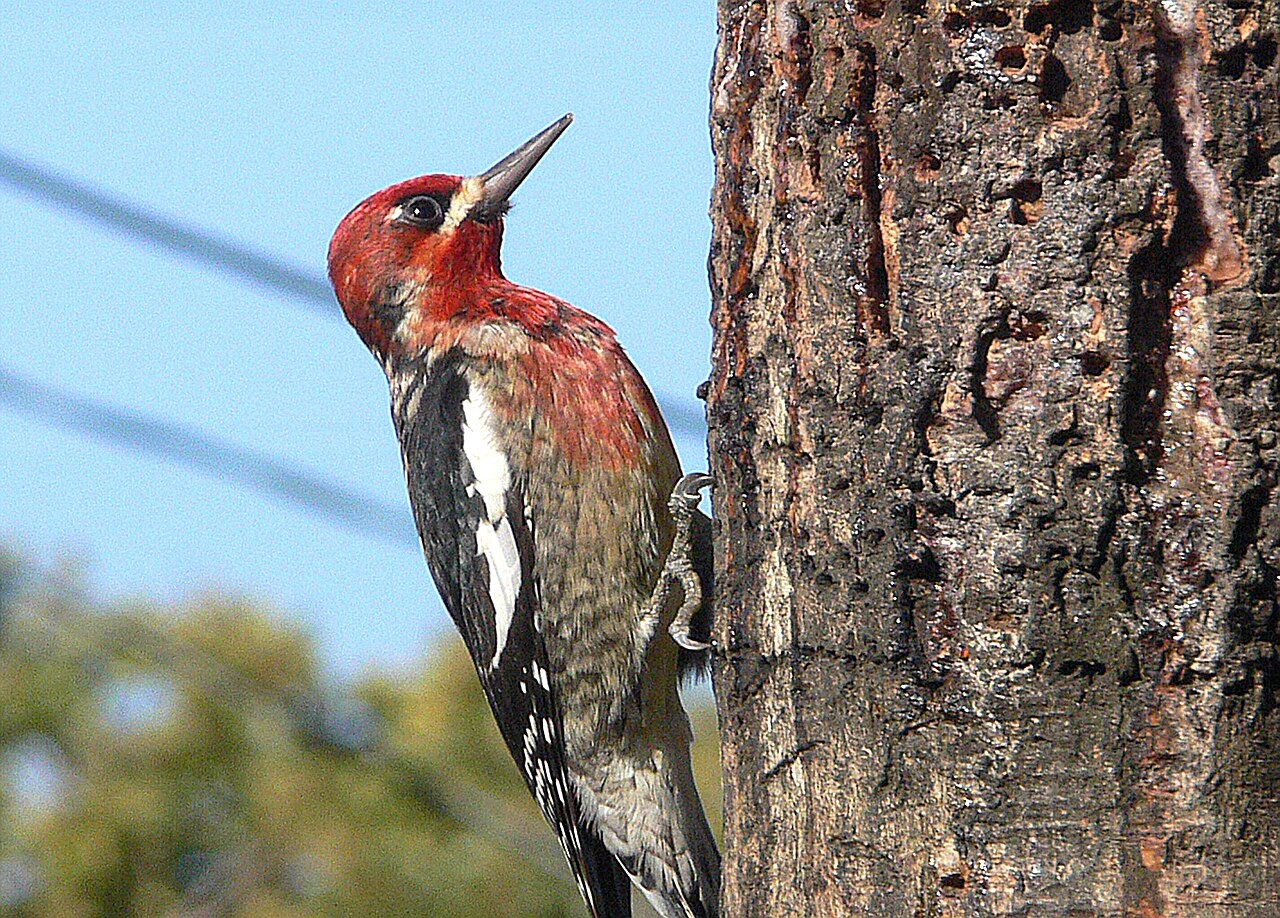
The Red-breasted Sapsucker (Sphyrapicus ruber) is the Pacific slope’s scarlet-headed woodpecker — the entire head, nape, and upper breast washed solid red over a black-and-white checkerboard back, with a bold white stripe on the folded wing. It drills neat horizontal rows of sap wells into birch, alder, cottonwood, and conifers, then returns all day to lap the sap and snatch the insects it attracts. To attract it: hang a suet cage near trunk cover, keep or plant birch and alder, and leave an established “well tree” untouched. Listen for the nasal mewing call and the irregular, stuttering drum roll. In Washington it is the only sapsucker that stays through winter, where it shares yards with the Northern Flicker and the Pileated Woodpecker.
Species Physical Profile & Morphometrics
The Red-breasted Sapsucker is a mid-sized member of the woodpecker family (Picidae), one of four sapsucker species in North America and the Pacific coast’s own — replacing the Yellow-bellied Sapsucker west of the Rockies. Its toolkit matches its trade: a short, stout drilling bill, a brush-tipped tongue for lapping sap, stiff tail feathers for bracing, and two-toes-forward feet for gripping bark.
The identification formula: solid scarlet head and breast + checkerboard back + bold white wing stripe + pale yellowish belly, on a trunk tattooed with rows of wells.
Essential Morphometric Field Marks:
- Body Length & Mass: about 7.9 to 8.7 inches (20–22 cm) and 1.5 to 1.9 ounces (43–55 grams) — robin-sized, in the same class as a Hairy Woodpecker.
- Wingspan: about 14.6 to 15.7 inches (37–40 cm); the long white wing panel shows even at rest and flashes in the bounding flight.
- Bill Structure & Color: A short, straight, chisel-tipped dark bill — and behind it, a tongue tipped with stiff bristles that works like a mop for sap.
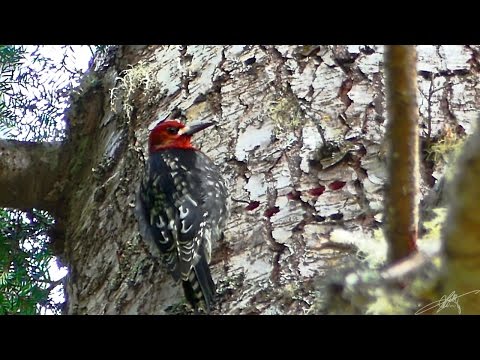
- Color Pattern: Head, nape, and upper breast entirely scarlet (a white or pale moustache stripe marks the face), back barred black-and-white in a checkerboard, rump white, belly pale with a yellow wash. Juveniles are mottled brown with the wing stripe already showing.
- Male vs. Female: The sexes look nearly identical — both wear the full scarlet hood; some females average slightly duller red with pale flecking on the throat, but plumage alone rarely separates them in the field.
Full scarlet hood: head, nape, and breast saturated red, typically at its most intense in breeding condition. Males do much of the territorial drumming in spring — that stuttering, decelerating roll from a dead branch is usually him.
Same hood, subtler sheen: the female wears essentially the same scarlet head and breast, sometimes a touch duller with pale speckling at the throat. She excavates, incubates by day, and tends wells with equal industry — tell the pair apart by behavior, not plumage.
Red-breasted Sapsucker Vocalization Guide (3 Clearly Labeled Simulations)
This is one of the quieter western woodpeckers: a nasal, squealing “mew” or “waa” is the everyday note, sometimes run into a chatter when the bird is worked up. The drumming has an irregular, decelerating cadence — a fast burst that stumbles into spaced taps. No freely licensed field recording of this species is currently archived on Wikimedia Commons, so all three cards below are clearly labeled acoustic simulations built to published descriptions; for real wild audio, browse xeno-canto: Red-breasted Sapsucker.
1. Call Simulation — The Nasal Mew
2. Drum Simulation — The Stuttering Roll
3. Call Simulation — The Excited Chatter
Habitat, Range & the Pacific Corridor
The Red-breasted Sapsucker belongs to the moist forests of the Pacific slope — coastal rainforest edges, mixed woods with aspen and alder, orchards, and shady suburban streets with mature trees — plus the pine-aspen belts of the Sierra Nevada and interior Southwest mountains.

Southeast Alaska to California
The range runs in a narrow ribbon from southeast Alaska through British Columbia and the western Washington–Oregon lowlands into northern California, with interior populations in the Sierra Nevada and the high mountains of the interior Southwest. Northern and high-elevation birds move downslope or toward the coast in winter; lowland birds of western Washington and Oregon barely move at all.
In Washington it is the only sapsucker that regularly winters — so a red-headed woodpecker at a Seattle-area maple in January is this species, every time.
Backyard Behavioral Patterns & Social Dynamics
The Red-breasted Sapsucker runs a sap farm on your trunk. Four behaviors explain most backyard encounters:
🩸 The Well Keeper
The bird drills horizontal rows of small holes — round wells in some trees, squarish in others — then patrols them daily, lapping sap with a brush-tipped tongue and re-drilling to keep the flow going. A favored birch, alder, or maple can carry years of tidy scarring.
🐜 The Ant Gleaner
Sap is only part of the menu: sapsuckers glean ants and beetles from bark, snatch insects in midair, and eat the cambium beneath the bark. In fall and winter, berries and fruit join the rotation.
🌸 The Hummingbird’s Patron
The wells feed a whole guild: Rufous Hummingbirds, warblers, bats, and squirrels all sip from them. In Alaska, Rufous Hummingbirds famously nest near active sapsucker trees and time their breeding to the sap flow — your well tree is a neighborhood café.
🏠 The Repeat Tenant
Pairs nest in aspen, alder, cottonwood, willow, or soft-hearted fir, often 50 feet up or more, and often return to the same tree year after year — though they chisel a fresh cavity each spring, leaving last year’s for owls, swallows, and squirrels.
Problem: “My Maple Is Covered in Neat Rows of Little Holes — What Did This, and Should I Stop It?”
The three most common Red-breasted Sapsucker puzzles all have reassuring answers:
First, the rows of holes: that is this bird’s farming, not borers or fungus — and on a healthy mature tree it is cosmetic. Sapsuckers often keep the same well tree for ten years or more without killing it. Second, the exception worth watching: drilling that forms a complete ring around a small or stressed trunk can girdle it. If a prized ornamental is being ringed, loosely wrap that stretch in burlap or hardware cloth for the season — the bird simply moves to the next tree. Third, the “is it a robin?” confusion: at a distance, that scarlet head and breast fools many first-time observers into reporting a strange robin. The vertical trunk posture, the drilling rows, and the white wing stripe settle it — no robin clings to bark.
Method 1: Set the Table — Suet & Winter Stations
Design for a sap specialist that visits suet when the sap runs slow:
-
Hang a Suet Cage Near Bark
Suet is the most dependable feeder draw for this species, especially in winter — hang the cage on or beside a trunk so the bird can cling vertically, the way it feeds at its wells. Insect-blend cakes nod to its mixed diet.
-
Time It for the Downslope Shift
In the Pacific lowlands, the best window opens in October, when mountain birds move down into yards and parks. Have the suet up before the first hard frost in the hills.
-
Offer Fruit in Cold Months
Apple halves or raisins impaled on a branch echo the species’ winter fruit habit — the same trick that works for the Red-bellied Woodpecker in the East.
-
Keep Water Open
A shallow bath near cover — heated where winters freeze — completes the station; sapsuckers drink and bathe like any backyard regular.
Method 2: Build the Habitat — Birch, Alder & Well Trees
Feed the habitat, and the sapsuckers follow:
-
Plant the Well Trees
Paper birch, red alder, bigleaf maple, and cottonwood are classic Pacific well trees; in the interior, aspen is the keystone. One mature birch can anchor a sapsucker’s winter territory by itself.
-
Never “Clean Up” a Well Tree
Leave the rows alone — no tar, no wrapping, no pruning-out. Old wells invite the bird back year after year, and they feed hummingbirds and butterflies through the seasons when flowers are scarce.
-
Keep a Snag Where Safe
A standing dead or fungus-softened trunk is nest real estate for next spring — and until then, a drumming post. Where a full snag is unsafe, a topped 12-to-20-foot trunk does the job.
-
Skip the Insecticides
The wells work because sap attracts insects, and insects feed the bird — an un-sprayed tree keeps the whole loop running: sap, bugs, sapsucker, hummingbirds.
Tool Solution: Recommended Hardware for Red-breasted Sapsuckers
Equipment matched to a trunk-feeding, sap-loving westerner:
Trunk-Mounted Suet Cage
A standard single or double suet cage hung flat against or beside a trunk — the layout a sapsucker recognizes instantly, since it matches how the bird clings to feed at its own wells.
- • Food: Insect-blend or peanut suet cakes
- • Style: Standard cage, trunk-adjacent
- • Placement: On or beside bark, quiet cover
Fruit & Suet Log Combo
A drilled suet log or a platform stocked with suet plus apple halves — covering both sides of this bird’s winter diet, sap-substitute fat and fruit, in one station the whole woodpecker guild can share.
- • Food: Suet plugs, apple halves, raisins
- • Style: Vertical log or drained platform
- • Placement: Near a well tree if you have one
Heated Bird Bath
A shallow basin with a thermostatic heater — wintering sapsuckers drink daily, and open water in a cold snap keeps the whole yard guild, from sapsucker to Downy Woodpecker, coming back.
- • Depth: 1–2 in, gently sloped
- • Winter: Thermostatic heater or de-icer
- • Placement: Open ground beside cover
Frequently Asked Questions
- Species Profile: The Red-breasted Sapsucker (Sphyrapicus ruber) is a 7.9–8.7 inch, 43–55 gram woodpecker (Picidae) of the Pacific slope — scarlet head and breast, checkerboard back, bold white wing stripe.
- ID in One Look: The only western woodpecker with the entire head and upper breast solid red; sexes look nearly alike, juveniles are mottled brown with the wing stripe already showing.
- A Short-Distance Mover: Northern and mountain birds shift downslope or coastward in winter; western Washington and Oregon lowland birds stay put — Washington’s only wintering sapsucker.
- The Sound: A nasal mewing “waa” plus an irregular, stuttering drum that decelerates — once learned, never confused with a Downy or Hairy.
- Feeder Formula: A trunk-adjacent suet cage, fruit in winter, water year-round — and a birch or alder left to host its wells.
- The Well Keeper: Its sap wells feed hummingbirds, warblers, bats, and squirrels; healthy trees tolerate the rows for years.
Bird Watching Log
Species: Red-breasted Sapsucker (Sphyrapicus ruber)
| Red-breasted Sapsucker (Adult / Juvenile — At Suet: Yes / No — Sap Wells Seen: Yes / No — Drumming Heard: Yes / No) | |