
Painted Bunting


Painted Bunting (Passerina ciris): Complete US Backyard Identification, Feeder Guide & Vocalization Library
Quick Answer: How to Attract & Identify Painted Buntings
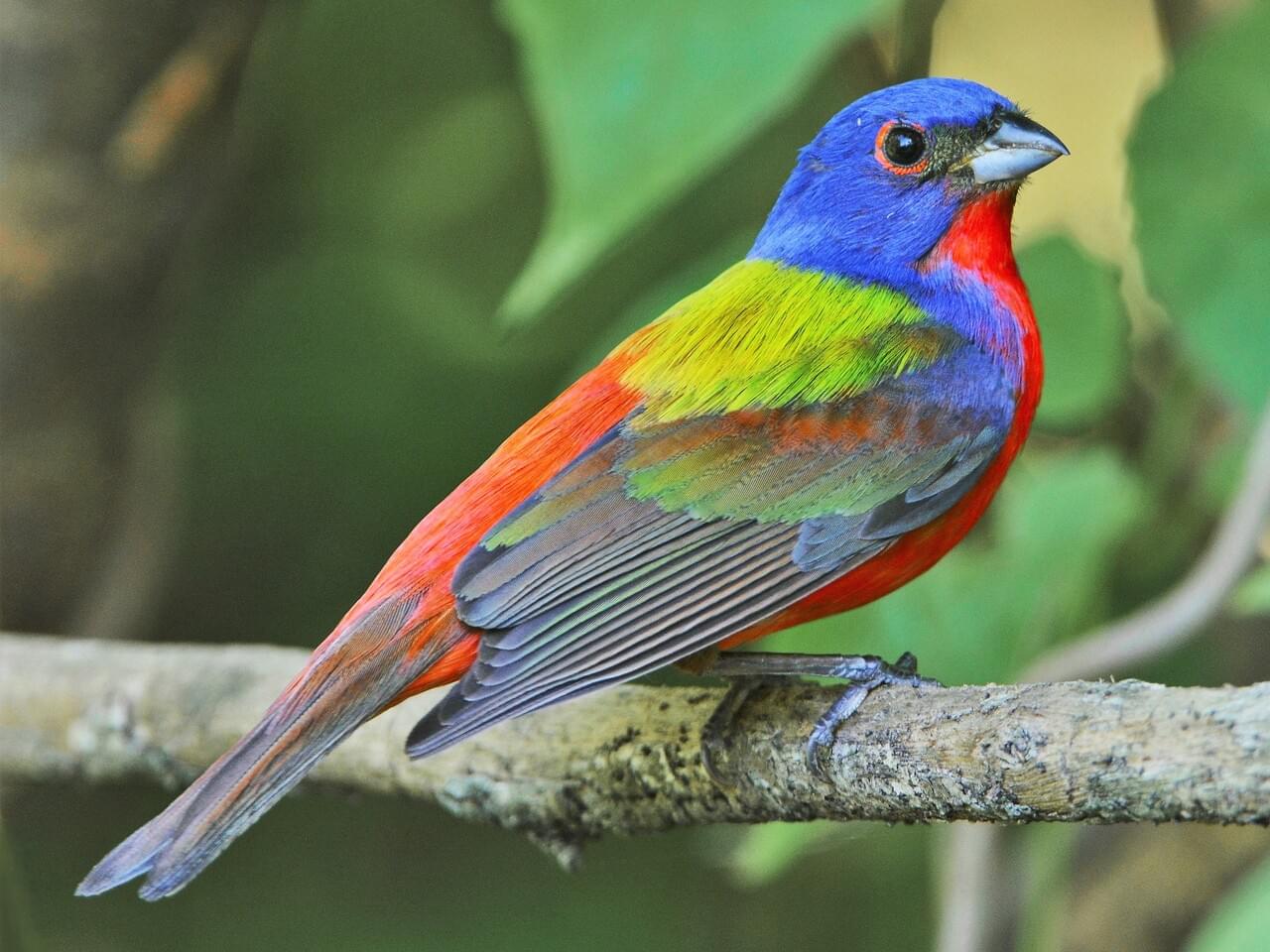
The Painted Bunting (Passerina ciris) is a small, sparrow-sized passerine celebrated as North America’s most colorful songbird. Adult males are instantly recognized by their brilliant royal indigo head, golden-lime green back, and blazing vermilion-scarlet throat, breast, and belly, while females and young males are completely uniform bright chartreuse / lime-green. In the United States, Painted Buntings occupy two geographically distinct populations across Texas/Oklahoma and coastal South Carolina, Georgia, and Florida. To attract these secretive birds to your yard, install a caged tube feeder or sheltered ground platform placed within 3 to 5 feet of dense native thickets (such as wax myrtles, yaupon holly, or saw palmetto), filled with 100% white proso millet, canary seed, and fine sunflower chips alongside an active dripping water mister.
Species Physical Profile & Morphometrics
Affectionately dubbed the nonpareil (“without equal”) by early French settlers in Louisiana, the Painted Bunting is a member of the cardinal family (Cardinalidae). Despite its dazzling tropical appearance, it shares the compact body form and seed-cracking beak of the closely related Indigo Bunting.
When observing backyard visitors, adult males cannot be mistaken for any other species on Earth. Females, however, are unique among North American songbirds: they are our only small passerine clothed entirely in vibrant yellow-green without bold wing bars, eyebrow stripes, or contrasting caps.
Essential Morphometric Field Marks:
- Body Length & Mass: Averages 4.7 to 5.5 inches (12–14 cm) with an adult weight of 0.5 to 0.7 ounces (14–19 grams), roughly matching the size of an American Goldfinch.
- Wingspan: Measures 8.3 to 9.1 inches (21–23 cm) with rounded, agile wing contours built for quick evasion through dense, thorny maritime tangles.
- Bill Structure: Features a stout, sharply conical seed-eating beak colored dull slate-gray or dark horn, specifically adapted for husking miniature grass seeds and weed grains.
- Delayed Plumage Maturation: Young males do not acquire their famous red, blue, and green plumage until their second autumn (around 14–16 months of age). First-year breeding males look identical to lime-green females but still sing loudly and defend nesting territories.
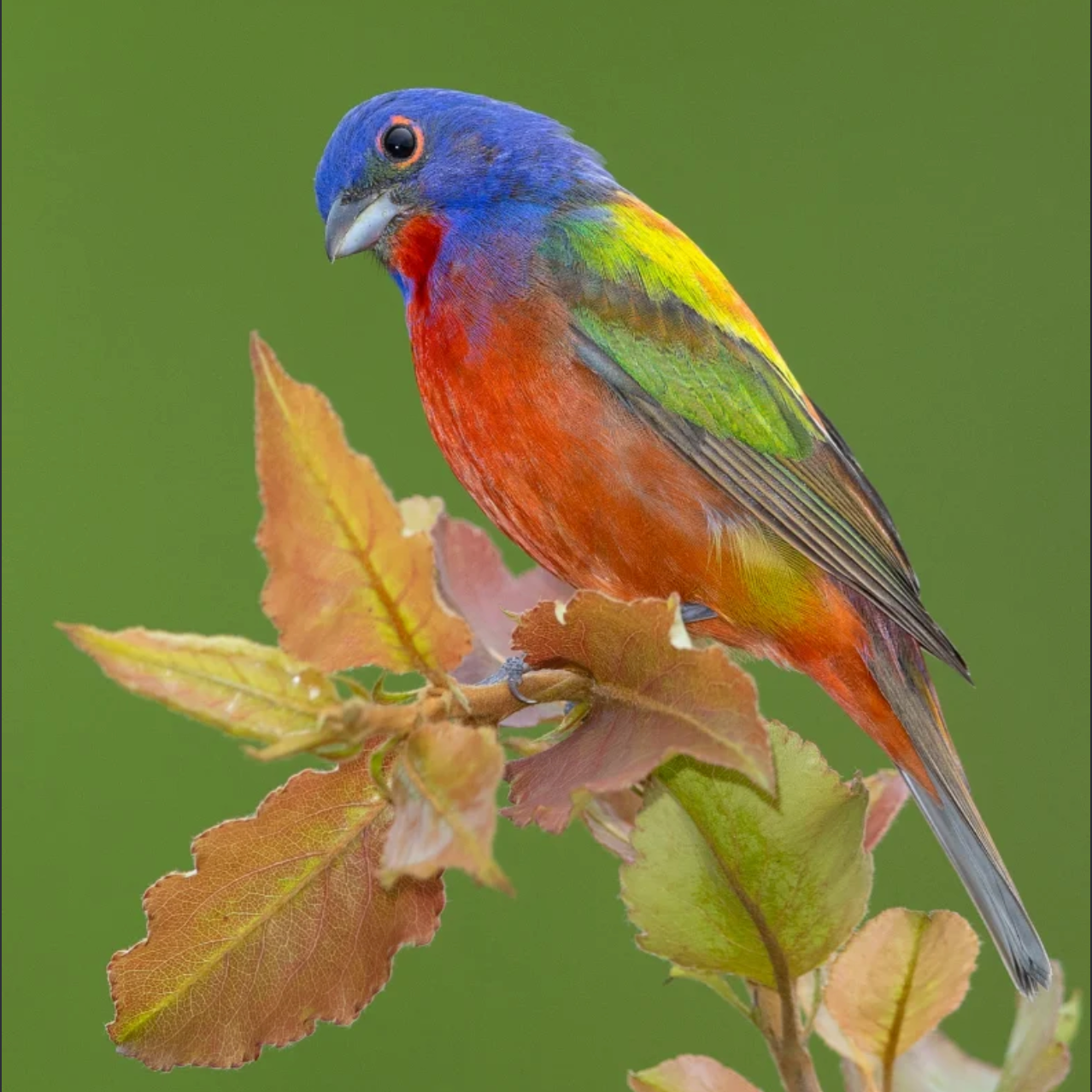
A breathtaking rainbow mosaic: luminous royal indigo-violet hood and nape, an electric lime-green to golden-bronze mantle, and pure scarlet-vermilion underparts from chin to undertail coverts, framed by dark wings and a distinctive red eye-ring.
Uniform, smooth bright chartreuse / lime-green across the crown, back, wings, and belly, slightly paler yellow-olive beneath. This brilliant green hue provides flawless concealment inside Spanish moss, palmetto fronds, and sunlit brush.
Bunting Vocalization Library (4 Key Sounds)
Despite their flashy colors, Painted Buntings spend much of their time deep inside dense vegetation, making their cheerful vocalizations the most reliable way to detect their presence. The song is a sweet, rolling, high-pitched musical warble delivered at a rapid tempo:
1. Sweet Musical Warble
2. Sharp “Chip” / “Click” Call
3. Dawn High-Canopy Song
4. Soft Whispered Chatter
Southern & Coastal US Range: Two Disjunct Populations
In the United States, Painted Buntings occupy maritime scrub, live oak hammocks, wax myrtle borders, pine-palmetto flatwoods, and mesquite savannas across two separate geographic breeding ranges:

Green = Eastern Coastal Breeding Range (FL, GA, SC, NC)
Blue = Wintering Grounds (South Florida, Keys, Caribbean).
Coastal Hammocks & Texas Savannas: Two Breeding Groups
Ornithologists recognize two distinct, non-overlapping populations of Painted Buntings in the US:
1. The Western Population: Breeds abundantly across Texas, Oklahoma, Arkansas, and Louisiana. In late summer, they migrate southwest into staging grounds in northern Mexico before wintering in Central America.
2. The Eastern Coastal Population: Confined strictly to a narrow coastal corridor (rarely more than 30 miles inland) extending from North Carolina through coastal South Carolina, Georgia, and northern Florida. Remarkably, thousands of Eastern buntings spend the winter directly in South Florida and the Florida Keys, visiting suburban backyard feeders from October through April!
Backyard Behavioral Patterns & Social Dynamics
Observing Painted Buntings in Southern and coastal yards reveals fascinating, highly secretive behavioral routines:
🌿 Deep Thicket Skulking
Painted Buntings are quintessential skulkers. Despite their bright plumage, they rarely expose themselves in open lawn space. They travel through yards along dense “hedgerow highways,” flitting between wax myrtles, yaupon hollies, and climbing vines to remain hidden.
⚔️ Fierce Male Territorial Combats
Male Painted Buntings are among the most aggressively territorial songbirds in North America. During spring territory establishment in Texas and Georgia, rival males will engage in intense physical grapple fights on the ground, locking claws and beating wings to claim prime hedgerows.
💧 Moving Water Obsession
In the humid heat of the South, buntings require daily bathing and drinking. They are irresistibly attracted to the sound of moving water; adding a dripping hose or solar fountain in a shady corner will draw them out of dense foliage even when feeders fail.
🌾 Selective Small-Seed Specialization
Their tiny, sharply conical bills are engineered for small weed seeds. In natural habitats, they delicately harvest seeds directly from weeping lovegrass, panic grasses, and wild dock, ignoring coarse seeds that require heavy crushing jaws.
Problem: Why Painted Buntings Avoid Standard Backyard Feeders
Many homeowners in Florida, Texas, and coastal Georgia know Painted Buntings live in their neighborhood, yet never see them on their backyard feeders. This feeder absence is almost always caused by three common feeding mistakes:
First, feeder placement is too exposed. Buntings will rarely venture into an open, manicured lawn to visit a feeder post mounted 20 feet away from shrubbery. If they feel exposed to Cooper’s Hawks or neighborhood cats, they will simply stay hidden. Second, standard grocery store wild bird blends are dominated by coarse corn, milo, and large sunflower seeds that bunting beaks cannot easily crack. Third, aggressive flock birds like House Sparrows, Brown-headed Cowbirds, and Blue Jays easily intimidate and bully timid buntings away from open perches.
Method 1: Install Caged Thicket Feeders & Low Brush Platforms
Reconfigure your feeder station to provide the shelter and security buntings crave:
-
Enforce the “3-Foot Thicket Rule”
Move your feeder within 3 to 5 feet of dense evergreen vegetation (such as wax myrtle, yaupon holly, saw palmetto, or thick jasmine trellis). Buntings must be able to dart into protective foliage in a fraction of a second.
-
Deploy Caged Tube Feeders (Sparrow Exclusion)
Use a finch tube feeder enclosed within a 1.5-inch wire exclusion cage. Tiny Painted Buntings can slip right through the mesh to feed peacefully, while larger bullies (jays, grackles, cowbirds, and squirrels) are physically blocked outside.
-
Set Up a Low-Mounted Screened Platform Tray
Mount an open wooden platform tray 3 to 4 feet off the ground tucked into a shady garden bed. Buntings naturally forage close to the soil and feel comfortable landing on flat, stable wooden edges.
-
Add an Active Water Dripper or Mister
Position a shallow bird bath (1 to 1.5 inches deep) equipped with a dripping hose attachment or solar mister right beside your thicket feeder. The continuous splashing sound is an irresistible acoustic signal for thirsty buntings.
Method 2: Offer 100% White Proso Millet, Canary Seed & Fine Chips
Provide the specific micro-seeds and summer insects tailored to bunting bill morphology:
-
Serve Pure White Proso Millet (The #1 Bunting Magnet)
While larger songbirds often ignore millet, pure white proso millet (Panicum miliaceum) is the ultimate food for Painted Buntings. Its smooth, round, thin hull allows bunting bills to husk hundreds of seeds an hour with zero effort.
-
Blend in Plain Canary Seed
Add 25% plain canary seed (Phalaris canariensis) to your millet. These small, elongated, nutrient-dense seeds provide rich carbohydrates and essential amino acids that arriving spring migrants need.
-
Provide Fine Hulled Sunflower Chips (Zero Waste)
Offer finely diced sunflower hearts (sunflower chips). Buntings cannot crack whole black-oil sunflower shells easily, but they greedily consume the high-fat meats (28% crude lipid core) when chopped fine.
-
Offer Live Mealworms During Summer Breeding
During June and July in Texas, Florida, and the coastal Carolinas, place small cups of live mealworms inside your caged feeder. The rich insect protein directly supports nesting females and hungry fledglings.
Tool Solution: Recommended Hardware for Painted Buntings
Specialized backyard equipment engineered to protect and feed small, secretive songbirds:
Caged Finch & Bunting Tube Feeder
Heavy-duty steel wire cage enclosing a clear polycarbonate seed tube to prevent squirrels and large bully birds from entering.
- • Cage Grid: 1.5 in wire spacing (Bunting safe)
- • Capacity: 1.25 lbs White Millet / Nyjer
- • Target Species: Buntings, Goldfinches, Siskins
Pure White Proso Millet & Canary Blend
A pristine 75/25 blend of triple-cleaned white proso millet and golden canary grass seed with zero red milo or corn filler.
- • Purity: 100% Edible Micro-Seeds
- • Target Species: Painted Buntings, Doves
- • Waste: Minimal lawn debris & high palatability
Shallow Cast Basin with Water Dripper
Low-profile textured basin featuring an active dripping water mister designed to attract secretive brush birds from hiding.
- • Water Depth: 1.25 in (Safe for small songbirds)
- • Acoustics: Continuous moving water ripple
- • Placement: Shady ground or low deck mount
Frequently Asked Questions
1. Tuck Feeders Directly Beside Thickets: Place feeders within 3 to 5 feet of dense native shrubs (wax myrtle, yaupon holly, saw palmetto, or climbing vines). Buntings are shy and will not cross wide, open lawn spaces to feed.
2. Serve 100% White Proso Millet & Canary Seed: Fill your feeders with pure white proso millet, canary seed, and fine sunflower chips. Bunting bills are small and specialized for these easy-to-husk micro-seeds.
3. Use Caged Feeders to Exclude Bully Birds: Install a wire exclusion cage around your feeder. Small buntings can easily slip inside, while aggressive House Sparrows, cowbirds, and grackles are locked out.
4. Provide an Active Dripping Bird Bath: Buntings require daily hydration in Southern heat and are passionately drawn to the acoustic sound of dripping or misting water in a shady corner.
• Wild Seeds & Grains: They harvest tiny seeds directly from native weeds and grasses, including panic grasses (Panicum), bristleglass, foxtail, pigweed, dock, and spurge.
• Insects & Spiders: During late spring and summer breeding, adults and growing nestlings consume vast quantities of grasshoppers, caterpillars, weevils, beetles, wasps, and spiders for essential protein.
• Backyard Feeder Favorites: At garden stations, their favorite food by far is white proso millet, followed closely by plain canary grass seed, finely chipped sunflower hearts (husked meats), and live mealworms.
• Uniform Chartreuse / Lime-Green: She is clothed entirely in vibrant yellow-green / lime-green across her crown, nape, back, wings, and tail, shading to a slightly paler yellow-olive on the breast and belly.
• North America’s Only Green Songbird: Unlike greenish warblers or vireos that have wing bars, eye stripes, or gray caps, the female Painted Bunting is the only small songbird in the United States that is completely, solidly bright green with no contrasting markings.
• Bill & Facial Marks: She features a short, stout, conical seed-cracking bill of dark slate-gray and large dark eyes encircled by a very faint pale eye-ring.
• Western Population: Breeds abundantly across Texas, Oklahoma, Arkansas, and Louisiana. In late summer, they migrate southwest into staging grounds in northern Mexico before wintering in Central America.
• Eastern Coastal Population: Confined strictly to coastal maritime strips in North Carolina, South Carolina, Georgia, and northern Florida. Remarkably, thousands of Eastern buntings spend the winter directly in Central and South Florida and the Florida Keys, visiting suburban backyard feeders from October through April!
- Species Profile: The Painted Bunting (Passerina ciris) is a 5-inch passerine recognized by the male’s multi-colored rainbow plumage (indigo, scarlet, lime) and the female’s unique all-green camouflage.
- Disjunct US Populations: Divided into a Western breeding population (Texas, Oklahoma, Louisiana) and an Eastern coastal population (Carolinas, Georgia, and winter residents in Florida).
- Feeder Hardware Needs: Requires wire-caged finch feeders or sheltered ground platforms placed within 3 to 5 feet of dense evergreen brush to exclude bully birds.
- Dietary Favorites: Thrives on pure white proso millet, golden canary seed, finely chipped sunflower hearts, and summer live mealworms.
- Delayed Maturation: Young males stay lime-green for their entire first year to avoid territorial combat with dominant adult males.
- Water Magnet: Providing a shallow bird bath with an active dripping water mister in shady cover is one of the most dependable ways to attract this secretive species.
Bird Watching Log
Species: Painted Bunting (Passerina ciris)
| Painted Bunting (Population: Coastal East / Texas-Inland: ________________) | |