
Evening Grosbeak


Evening Grosbeak (Hesperiphona vespertina): Complete Identification, Irruption Guide & Feeder Library
Quick Answer: How to Attract & Identify Evening Grosbeaks
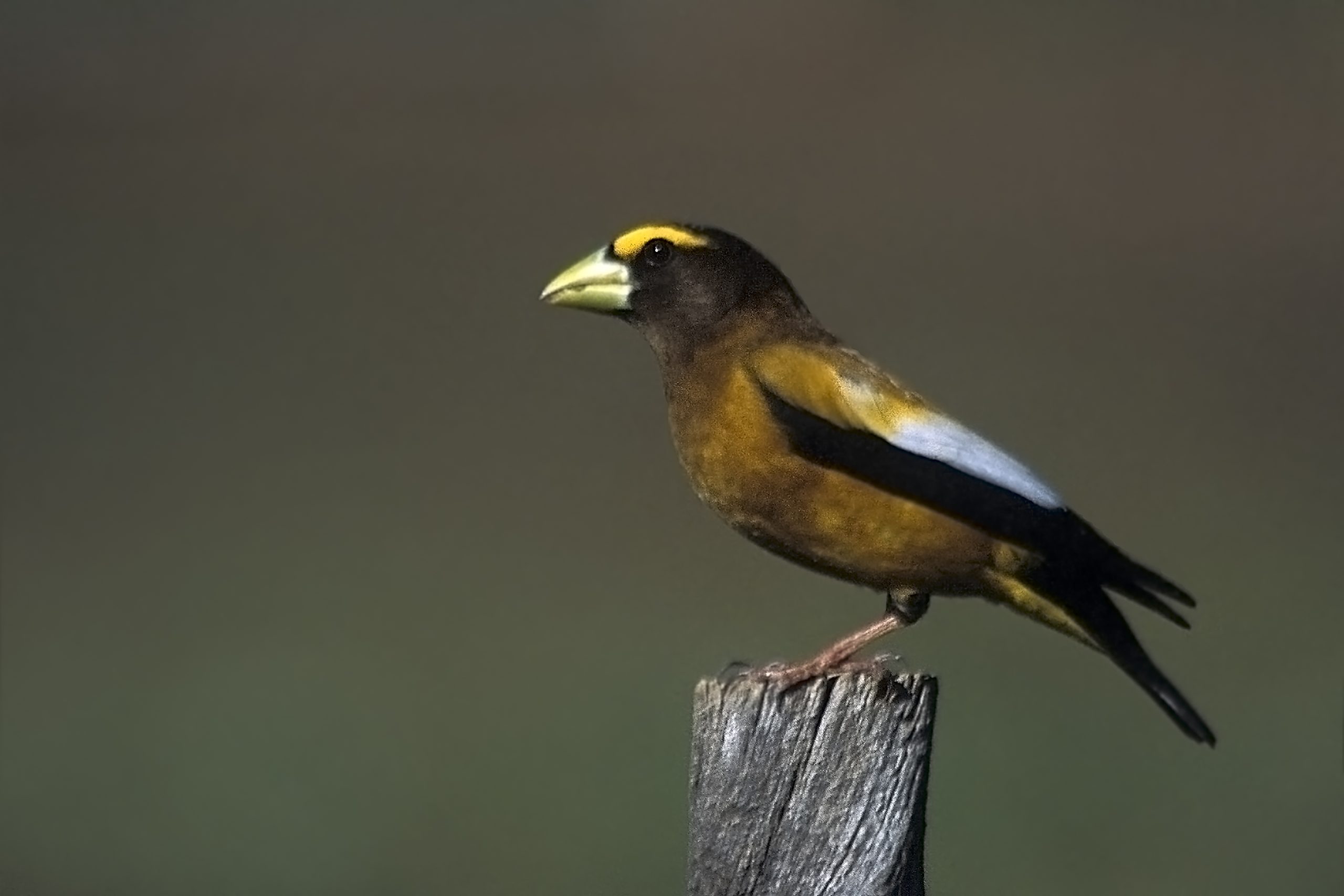
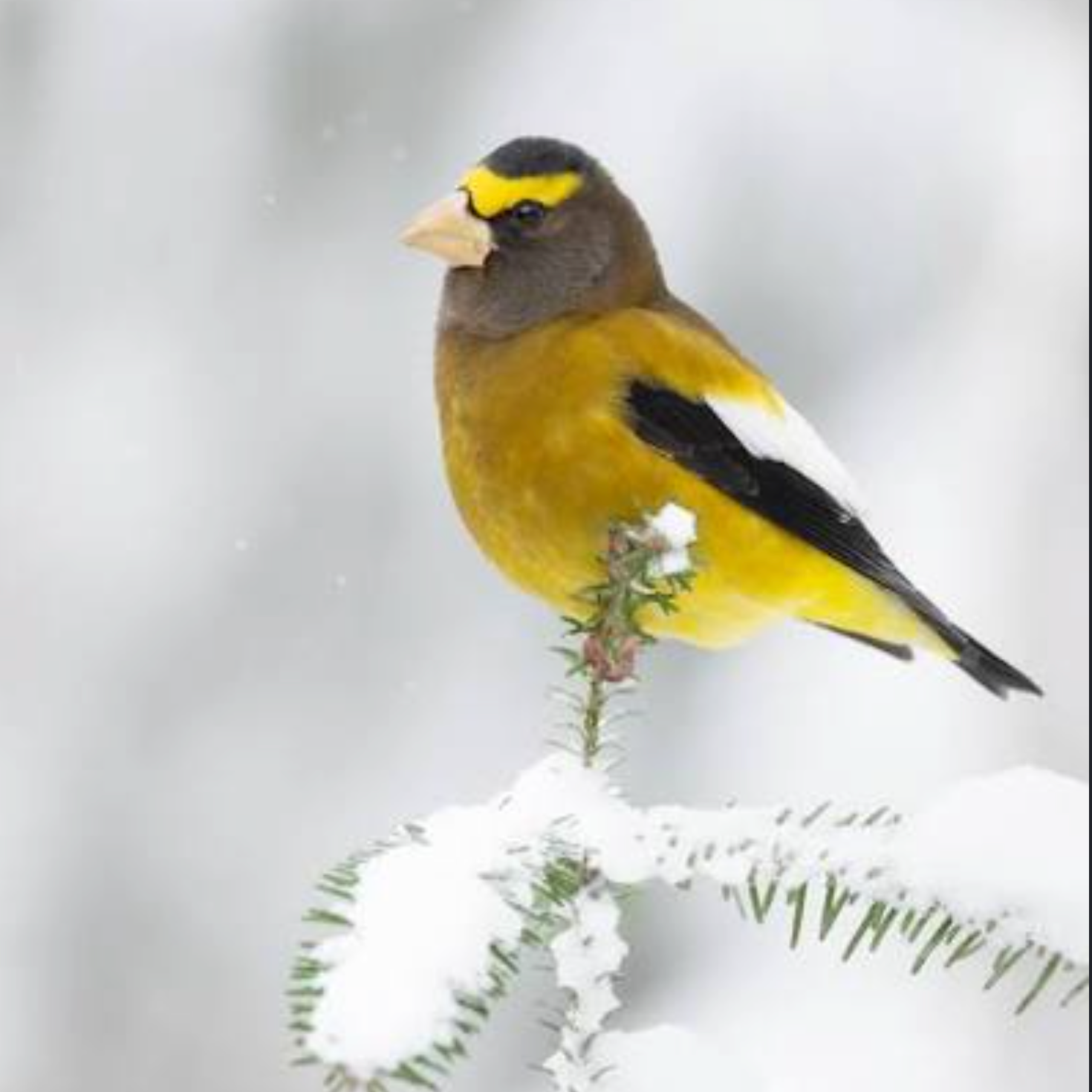
The Evening Grosbeak (Hesperiphona vespertina) is a stocky, big-headed finch recognized instantly by its massive pale ivory-green bill and — on males — a bold yellow forehead band, golden body, and black wings with a large white patch. Females are softer gray with a yellow wash on the neck and breast. This is an irruptive winter finch: it breeds in northern and montane conifer forests, then floods south into backyard feeders only in years when boreal seed crops fail. When an irruption hits your area, attract flocks with striped and black oil sunflower seeds on a large, stable platform or hopper feeder mounted 5 feet high within 15 feet of coniferous cover — and keep it stocked from December through March, because a single flock can empty a feeder in a day.
Species Physical Profile & Morphometrics
The Evening Grosbeak is built like a feathered linebacker: thick-necked, big-headed, and short-tailed, with a bill so oversized it looks almost parrot-like. Despite the “grosbeak” name it is a true finch (Fringillidae), not a relative of the cardinal-family grosbeaks such as the Rose-breasted Grosbeak. Older field guides list it under the former scientific name Coccothraustes vespertinus.
When confirming an identification, rule out the Pine Grosbeak (rose-red rather than yellow, with a noticeably slimmer dark bill and longer tail) and the American Goldfinch (much smaller at under half the weight, with a tiny pink bill).
Essential Morphometric Field Marks:
- Body Length & Mass: Averages 6.3 to 7.1 inches (16–18 cm) with an adult mass of 1.9 to 2.6 ounces (53–74 grams) — heavier than a Northern Cardinal and nearly four times the bulk of a goldfinch.
- Wingspan: Measures 11.8 to 14.2 inches (30–36 cm), with broad, powerful wings that flash a bold white patch in flight.
- Bill Structure & Color: An enormous pale ivory to greenish-yellow conical bill engineered for crushing large, hard seeds — striped sunflower hulls that defeat smaller finches open instantly.
- Head Markings: Males wear a brilliant yellow forehead and eyebrow band set against a dark chocolate-brown head; females show a cleaner gray head with a neat pale bill.
Dark brown head capped by a blazing yellow brow stripe, body shading from brown through gold to bright lemon-yellow on the belly and rump. Wings are jet black with a large, clean white patch that blinks in flight; tail black.
Predominantly soft silver-gray on the head and back with a gentle yellow wash across the neck and breast and a whitish belly. The wings carry the same black-and-white pattern as the male, and the huge pale greenish bill confirms the species at any distance.
Evening Grosbeak Vocalization Library (2 Key Recordings)
Despite the name, Evening Grosbeaks do not restrict their voices to dusk — they call loudly all day long. They are far better known for piercing flock calls than for song: the true song is a short, halting warble heard mainly on the breeding grounds and rarely at winter feeders.
1. Flock Foraging & Contact Calls
2. Flight Calls & Halting Warbled Song
Habitat Range & Irruptive Winter Biology
Evening Grosbeaks breed in mature coniferous and mixed forests — spruce, fir, and pine — across Canada, the northern tier of the United States, and south along the western mountain chains (Cascades, Sierra Nevada, and Rockies as far as New Mexico). They are birds of the treetops, nesting high in conifers and feeding on buds, samaras, and insects.

Irruptive, Not Annual: The Boom-and-Bust Winter Finch
Unlike calendar-true migrants, Evening Grosbeaks move south only when northern seed crops fail. In “flight years,” flocks pour out of the boreal forest into the northern and central states, famously swarming feeders in places like Minnesota’s Sax-Zim Bog. In good crop years they remain in Canada and backyard sightings collapse to zero.
Historically, irruption flocks numbered in the hundreds and were a dependable winter spectacle across the Northeast and Midwest. Today the species has suffered one of the steepest declines of any North American landbird — long-term monitoring indicates losses of roughly 90% since 1970 — making every irruption flock at a backyard feeder a genuinely special event.
Backyard Behavioral Patterns & Social Dynamics
Evening Grosbeaks run on a feast-or-famine ecology, and their four signature behaviors all trace back to life in the northern forest:
❄️ Boom-and-Bust Winter Irruptions
These finches are irruptive wanderers, not schedule-keeping migrants. Their winter movements track cone, ash, and maple seed crops: when the boreal larder empties, flocks push hundreds of miles south; when it overflows, they stay home. That is why your feeder can host fifty birds one December and none the next.
🐛 Spruce Budworm Specialists
On the breeding grounds, Evening Grosbeaks time nesting to spruce budworm outbreaks and stuff their nestlings with budworm larvae — a single pair can deliver thousands of caterpillars. Mid-20th-century budworm epidemics coincided with grosbeak population highs, and modern budworm suppression is a suspected driver of the species’ steep decline.
🧂 Winter Salt & Grit Gatherers
Winter flocks famously descend onto salted highways and gravel driveways to swallow salt crystals and mineral grit that aid digestion. This habit makes them tragically vulnerable to vehicle collisions — drive slowly on back roads when you spot a flock feeding roadside.
🍽 Shoulder-to-Shoulder Feeder Flocks
At feeders, Evening Grosbeaks arrive as a noisy, cohesive squadron, packing tightly onto platforms and trading constant “cleer” contact calls. They dominate smaller birds by sheer bulk and can drain a stocked feeder in a single day — a breathtaking spectacle, and an expensive seed bill.
Problem: Why Evening Grosbeaks Pass Your Feeders By
Even in irruption years, many northern homeowners hear flocks calling overhead yet never see one land. The usual culprits are scale, stability, and seed:
First, this is a big, flocking bird — a 60-gram grosbeak cannot balance on swinging tube feeders or 1-inch dowel perches, and a flock of twenty needs landing room that small feeders simply do not provide. Second, cheap grocery-store mixes padded with red milo and wheat filler are ignored; grosbeaks sift straight past them for sunflower. Third, exposed feeders far from coniferous cover feel unsafe to a species that lives its life in spruce and fir tops. Fix all three and an irruption flock will find you.
Method 1: Build Flock-Scale, Rock-Steady Feeding Stations
Evening Grosbeaks feed in groups — engineer for the crowd, not the individual:
-
Install an Oversized Cedar Platform or Hopper Feeder
Choose a feeder with at least 3-inch-wide perimeter ledges and room for a dozen birds at once. Our lab-tested roundup of the Best Platform Feeders for Large Flocks compares the sturdiest models.
-
Pole-Mount at 5 Feet with Zero Sway
Anchor the feeder on a rigid 1-inch steel pole set 5 feet high with a ground auger. A flock landing in unison delivers a real shock load — any wobble sends nervous birds back to the treetops.
-
Anchor the Station Near Coniferous Cover
Place feeders within 10–15 feet of spruce, fir, or pine. Grosbeaks stage in conifer tops between feeding runs, and a station touching their natural habitat outperforms an identical one over open lawn.
-
Run Two Stations During Irruption Winters
When a flight year hits, a second platform on the opposite side of the yard doubles capacity and reduces squabbling, letting the whole flock feed at once instead of rotating through in stressed waves.
Method 2: Stock the Right Seeds on an Irruption Calendar
Match the menu to a bill built for crushing, and the calendar to the boreal seed crop:
-
Lead with Striped Sunflower — Yes, the Thick Shells
Striped sunflower hulls stop chickadees and goldfinches, but a grosbeak’s bill pops them like peanut shells. A 50/50 blend of striped and black oil sunflower is the single best Evening Grosbeak offering. See our breakdown on Black Oil vs. Striped Sunflower Seed.
-
Purge Filler Grains Entirely
Red milo, oats, and cracked wheat are dead weight for grosbeaks and simply get bulldozed off the platform onto the ground, where they feed rodents. Buy straight sunflower during irruption winters.
-
Plant Box Elder, Maple, and Ash for Natural Samaras
In the wild, grosbeaks pry apart winged “helicopter” seeds (samaras) of box elder, maples, and ash. A yard with mature seed-bearing hardwoods holds flocks longer than seed alone ever will.
-
Provide Open Water Through Deep Winter
A heated bird bath is a powerful December-to-March magnet: after dry seed meals, entire flocks drop in to drink together, exactly like the New Mexico puddle scene in our gallery. See the Best Heated Bird Baths.
Tool Solution: Recommended Hardware for Evening Grosbeaks
Heavy-duty equipment sized for big-bodied finches arriving in flocks:
Oversized Cedar Platform Feeder
Extra-wide landing ledges and a deep seed floor built to host a dozen heavy finches at once without flexing or sway.
- • Capacity: 8 lbs Sunflower
- • Ledge Width: 3.5 inches wide
- • Mount: 1-inch Pole Mount Ready
Striped + Black Oil Sunflower Blend
A 50/50 mix of thick-hulled striped and thin-hulled black oil sunflower that matches the grosbeak’s crushing bill and high fat demand.
- • Purity: 100% Sunflower (No Filler)
- • Bill Match: Built for Large Seed Eaters
- • Fat Content: High-lipid winter fuel
All-Season Heated Bird Bath (75W)
Thermostatically controlled basin that keeps drinking water open through northern freezes — a proven flock magnet after dry seed meals.
- • Thermostat: Activates at 35°F auto
- • Depth: 2 in (Safe for large finches)
- • Rim: Wide grip perch ring
Frequently Asked Questions
- Species Profile: The Evening Grosbeak (Hesperiphona vespertina) is a 6–7 inch true finch with a massive ivory-green bill; males wear a yellow brow band and bold white wing patch, females soft gray with a yellow wash.
- Irruptive Winter Finch: It does not migrate on a calendar — flocks push south only when boreal seed crops fail, so backyard numbers boom and bust between winters.
- Feeder Formula: Large, pole-mounted cedar platforms stocked with striped and black oil sunflower, within 10–15 feet of conifer cover, stocked December through March.
- Budworm Ecology: Nestlings are raised on spruce budworm larvae, and historic population highs tracked budworm outbreaks.
- Conservation Alert: Populations have fallen roughly 90% since 1970; every irruption flock at your feeder is a notable event worth logging and reporting.
- Feeding Style: Expect noisy, shoulder-to-shoulder flocks of 20–50 that can empty a feeder in a day — and roadside salt-and-grit gatherings that need careful drivers.
Bird Watching Log
Species: Evening Grosbeak (Hesperiphona vespertina)
| Evening Grosbeak (Subspecies / Notes: ____________________________) | |