
Northern Cardinal



Northern Cardinal (Cardinalis): Complete Identification, Feeder Guide & Vocalization Library
Quick Answer: How to Attract & Identify Northern Cardinals
The Northern Cardinal (Cardinalis) is a medium-sized songbird easily recognized by its prominent crest, heavy coral-red conical seed-cracking bill, and jet-black facial mask (grey on females). Cardinals are strictly non-migratory permanent residents across eastern, central, and southwestern North America, frequently foraging alongside winter ground companions like Dark-eyed Juncos and Black-capped Chickadees. Because their large bodies require a forward perching posture, cardinals cannot use swinging tube feeders; to reliably attract them to your yard, install a firm, wide platform tray or heavy wooden hopper feeder placed 5 feet above the ground and filled with high-fat black oil sunflower seeds or pure safflower seeds within 10 feet of dense evergreen shrubbery.
Species Physical Profile & Morphometrics
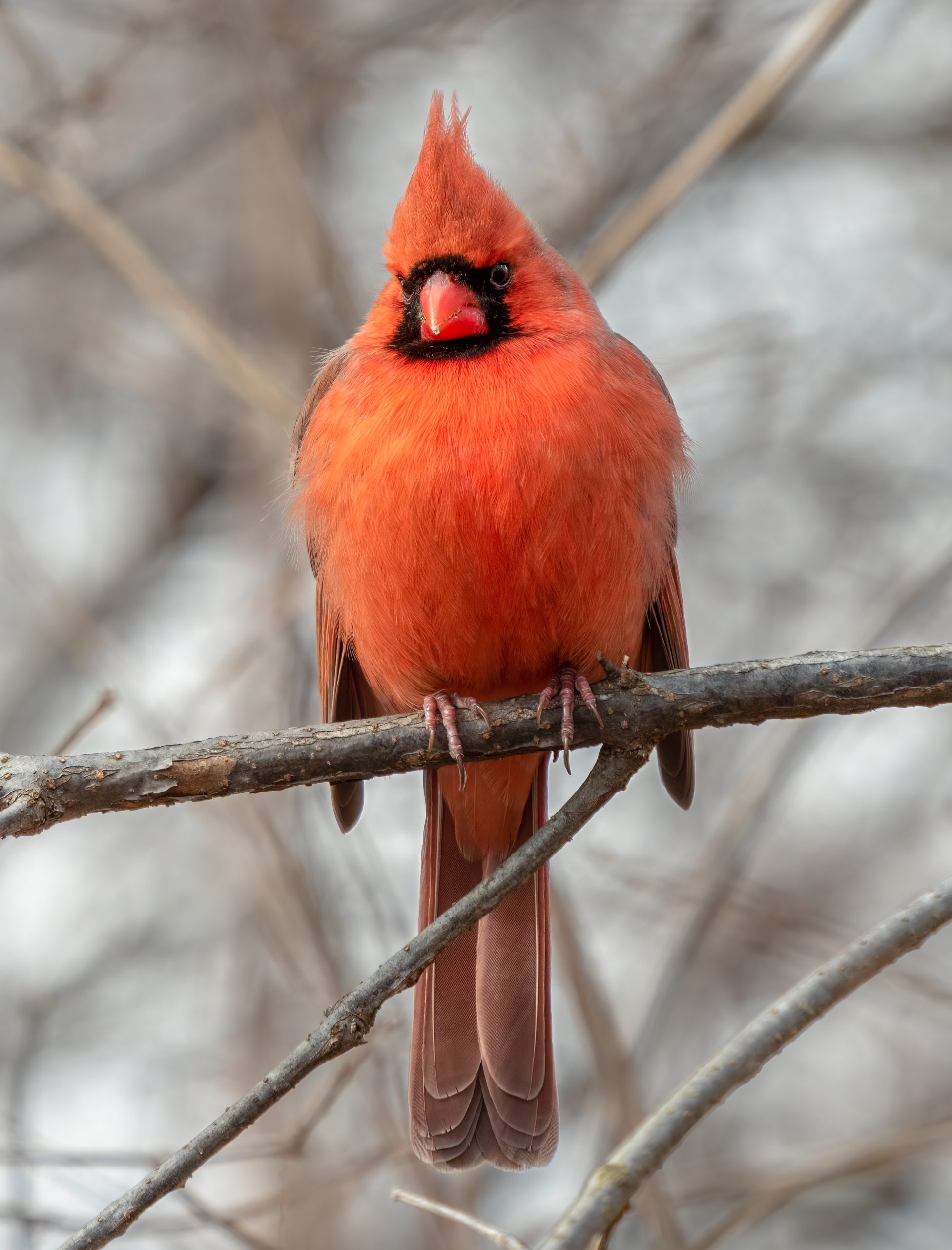
Unlike slender finches or warblers, the Northern Cardinal possesses a distinctively robust, chest-heavy silhouette. Both sexes display the characteristic erectile feathered crest that raises high when defending territory or alarmed, and lies flat along the crown when at rest.
When making field identifications, note that the cardinal differs sharply from the crestless Summer Tanager (which has an all-red body but lacks a black face mask) and the Scarlet Tanager (which features contrasting pitch-black wings). In arid southwestern borders, see our detailed guide on distinguishing cardinals from the desert-dwelling Pyrrhuloxia (Desert Cardinal).
Essential Morphometric Field Marks:
- Body Length & Mass: Averages 8.3 to 9.1 inches (21–23 cm) with an adult mass between 1.5 and 1.9 ounces (42–48 grams), nearly double the bulk of an American Goldfinch.
- Wingspan: Measures 9.8 to 12.2 inches (25–31 cm) with rounded wing tips designed for rapid evasive burst flight rather than long-distance endurance.
- Bill Structure & Color: Features an extraordinarily stout, bulbous conical seed-cracking beak colored a bright coral-red to reddish-orange in adults. This powerful jaw musculature delivers up to 10 times the crushing force of same-sized passerines.
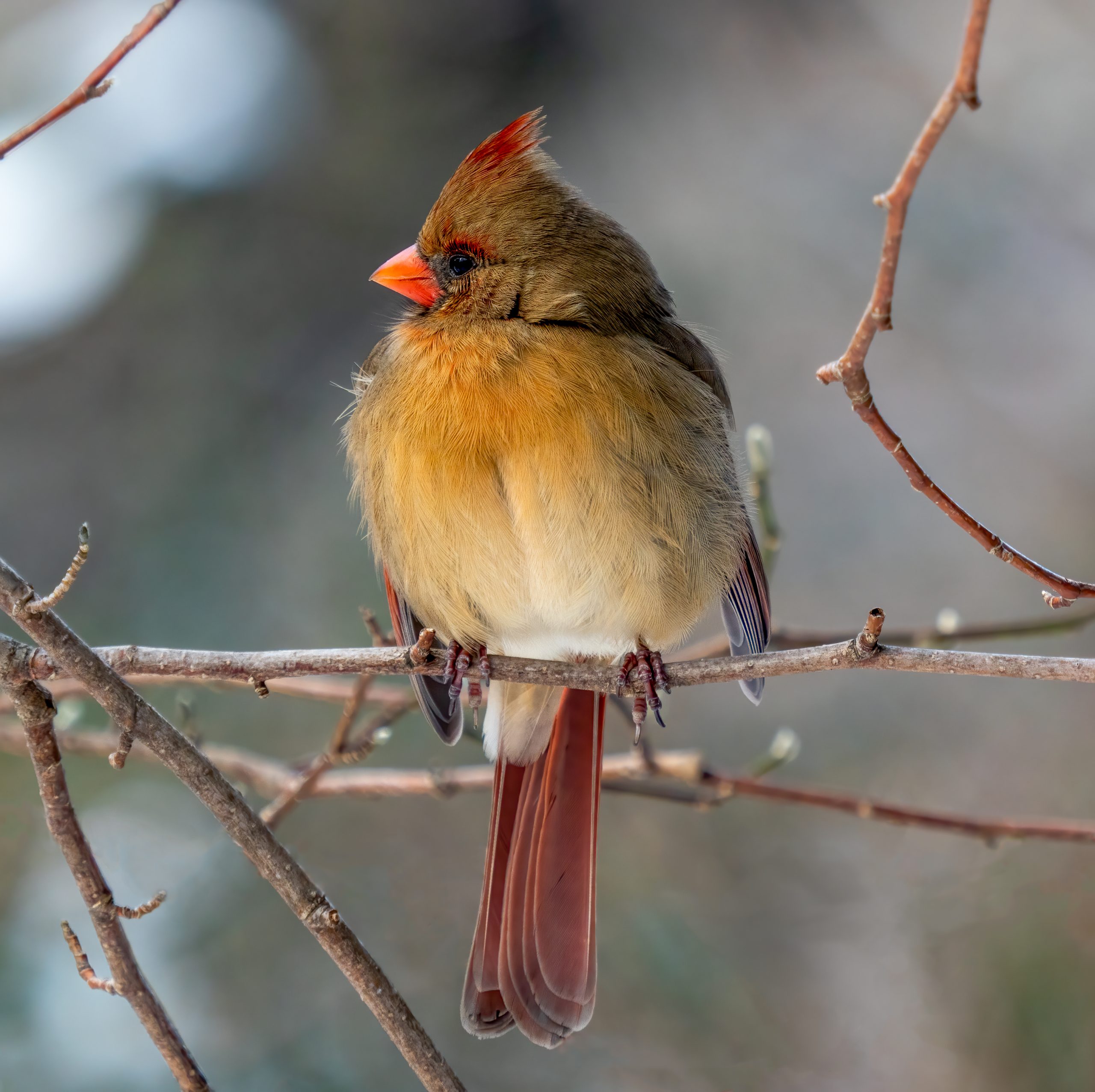
- Facial Mask: Displays an unbroken, velvety jet-black mask extending from the eyes down around the throat and chin (softer slate-grey on adult females).
Drenched in brilliant, uniform scarlet-red feathers from crest to underparts, accented by a deeper vermilion on the wings and back. The facial mask is pitch black with crisp margins that contrast sharply against the bright red crown and throat.
Predominantly warm fawn or yellowish-olive grey on the back and breast, providing essential camouflage during nesting. Females retain crimson-tipped feathers on the crest, wings, and tail, combined with the matching bright orange-red conical bill.
Cardinal Vocalization Library (4 Key Sounds)
Unlike the majority of North American songbirds where singing is restricted solely to males, both male and female Northern Cardinals sing complex songs. In acoustic tempo, cardinal whistles can superficially recall the loud calls of the Tufted Titmouse, but carry a much broader metallic pitch range. The female often sings from the nest while incubating, communicating food needs and perimeter security to her mate.
1. Clear Whistled Song
2. Cascading Syllables
3. Contact & Warning Call
4. Whisper Song & Mate Duet
Habitat Range & Non-Migratory Biology
Northern Cardinals occupy forest edges, overgrown hedgerows, suburban garden borders, and dense residential shrubbery. They actively avoid deep, contiguous interior old-growth forests and open arid grasslands that lack dense low-canopy nesting cover.

Strictly Non-Migratory: State Representation & Winter Flocks
As testament to its cultural prominence, the Northern Cardinal is honored as the official state bird in 7 states: Illinois, Indiana, Kentucky, North Carolina, Ohio, Virginia, and West Virginia. It is also an established year-round resident in New England, including coastal Maine.
In subzero winter months, cardinal pairs dissolve their fierce springtime territorial boundaries to assemble into loose winter survival flocks of 10 to 30 individuals. They forage calmly alongside other ground-feeders like Dark-eyed Juncos and White-throated Sparrows.
Backyard Behavioral Patterns & Social Dynamics
Observing cardinals from a kitchen or patio window reveals distinct, highly predictable behavioral routines. Unlike opportunistic wandering flocks, cardinals follow strict social rituals throughout the four seasons:
🌅 Crepuscular Schedule (First & Last Visitor)
Cardinals are strictly crepuscular foragers. They are almost invariably the first songbirds to land on seed trays at twilight dawn (often 20 minutes before sunrise) and the last to leave in the evening dusk. Their large dark eyes afford superior low-light vision, allowing them to feed safely while daytime raptors like Cooper’s Hawks sleep.
💑 Courtship Feeding (Beak-to-Beak “Kissing”)
In early spring (March through May), mated pairs engage in courtship mate-feeding. The male selects a choice black-oil sunflower seed, cracks the hull, tilts his head sideways, and tenderly places the kernel directly into the female’s bill. This ritual reinforces lifelong monogamous pair bonding and proves his provisioning capability.
🪞 Territorial Mirror & Window Pecking
During breeding territory establishment, male cardinals vigorously patrol boundaries. If they glimpse their reflection in patio sliding glass, car side mirrors, or shiny bumpers, they mistake it for an aggressive rival and will repeatedly flutter against the glass for hours. To permanently resolve this, follow our guide on How to Stop Backyard Birds from Pecking Windows & Mirrors.
❄️ Communal Winter Flock Tolerance
While spring and summer bring fierce territorial skirmishes, late autumn triggers a complete behavioral reversal. Cardinals temporarily suppress hostility to form winter survival foraging cohorts (10–25 birds). They gather peacefully on wide platform trays to maximize foraging efficiency during severe freezes.
Problem: Why Northern Cardinals Avoid Your Backyard Feeders
Many homeowners purchase premium wild bird food only to discover that smaller birds like American Goldfinches and Chickadees flock to the yard while cardinals remain aloof in surrounding tree branches. This occurs because the Northern Cardinal’s unique anatomical build makes typical feeder setups physically uncomfortable or hazardous for them:
First, cardinals are heavy-bodied ground foragers with rigid forward-pointing toes. They cannot easily cling vertically to hanging mesh socks, wire suet baskets, or skinny 1-inch dowel perches on swaying plastic tube feeders. When a feeder tips or sways under their 45-gram weight, cardinals feel off-balance and immediately abandon it. Second, aggressive flocking birds like European Starlings and House Sparrows readily overwhelm flimsy feeders, driving cautious cardinals back into dense thickets.
Method 1: Install Wide-Perch, Stable Feeding Stations
Follow these sequential adjustments to eliminate mechanical feeding frustration for cardinals:
-
Select Platform Trays or Weighted Wooden Hopper Feeders
Choose a feeder with an expansive flat wooden floor or a wrap-around perimeter landing ledge at least 2.5 inches wide. Review our lab-tested list of the Best Cardinal Feeders for Large Songbirds to choose the right model.
-
Anchor the Feeder onto a 1-Inch Heavy Steel Pole
Avoid hanging feeders from thin, wind-whipped tree branches. Mount your wooden hopper onto a rigid 1-inch diameter steel pole set 5 feet above the turf. Use a stabilizing ground corkscrew auger to prevent tilting.
-
Enforce the 10-Foot Shrub Shelter Buffer
Cardinals are wary of raptors (such as Cooper’s Hawks). Situate your feeding post exactly 8 to 10 feet from dense evergreen shrubs (e.g., yews, junipers, or arborvitae). This is close enough for a safe retreat, yet far enough to prevent lurking house cats from pouncing.
-
Provide Early Morning and Twilight Feeding Routines
Cardinals are predictably the first birds to arrive at dawn (often before sunrise) and the last birds to feed before full darkness. Ensure seed trays are refilled before twilight to cater to their crepuscular feeding habits.
Method 2: Optimize Seed Blends to Repel Pests & Maximize Calories
Fine-tune seed presentation to match the cardinal’s heavy bill while deterring nuisance competitors:
-
Eliminate Filler Seeds (Red Milo, Oats, and Wheat)
Commercial grocery store “wild bird mixes” consist of up to 60% red milo, cracked wheat, and filler grains. Cardinals kick these onto the soil, which attracts rats and squirrels. Discard cheap filler mixtures entirely.
-
Offer 100% Pure Black-Oil Sunflower Seeds
Black-oil sunflower seeds possess thin outer hulls that cardinal bills easily snap open, yielding a nutrient-dense meat consisting of 28% crude fat and 16% protein. See our breakdown on Black Oil vs. Striped Sunflower Seed for Songbirds.
-
Deploy Safflower Seed as an Anti-Pest Secret Weapon
If squirrels, purple grackles, or house sparrows crowd your platform, switch exclusively to white safflower seed (Carthamus tinctorius). Read our complete guide to Pure White Safflower Seed to understand why pests reject it while cardinals feast.
-
Scatter Coarse Seeds Along Clean Low Trays
Because cardinals naturally forage in leaf litter, sprinkle two handfuls of sunflower hearts and whole dried peanuts (favored also by Blue Jays) along low garden platform tables or ground trays raised 12 inches off the turf.
Tool Solution: Recommended Hardware for Northern Cardinals
High-performance backyard equipment engineered for large, heavy-bodied songbirds:
Cedar Hopper Feeder with Catch Tray
Heavyweight rot-resistant cedar construction featuring dual wide perching ledges and an expanded seed catch tray.
- • Capacity: 6 lbs Black Oil Sunflower
- • Perch Width: 3.2 inches wide
- • Mount: 1-inch Pole Mount Ready
Golden Safflower & Sunflower Heart Blend
A 50/50 blend of thin-hulled nutra-safflower and shelled sunflower meats for zero lawn mess and total squirrel deterrence.
- • Purity: 100% Edible (No Shells)
- • Pest Resistance: Squirrel & Starling Proof
- • Fat Content: 32% Lipid Core
All-Season Heated Bird Bath (75W)
Thermostatically controlled cast basin that keeps drinking water thawed down to -20°F without boiling or overheating.
- • Thermostat: Activates at 35°F auto
- • Depth: 1.5 in (Safe for songbirds)
- • Rim: Textured grip perch ring
Frequently Asked Questions
- Species Profile: The Northern Cardinal (Cardinalis) is an 8–9 inch non-migratory songbird identified by its prominent crest, coral-red bill, and black face mask.
- Non-Migratory Resident: Cardinals maintain the same geographic home range 365 days a year across eastern, central, and southwestern North America, grouping into small foraging flocks in winter.
- Anatomical Feeder Needs: Large bodies and rigid forward-facing toes require wide, stable platform trays or heavy hopper perches rather than swinging tubes.
- Dietary Superfoods: Black oil sunflower seeds provide essential winter lipids, while pure safflower seed repels nuisance squirrels, grackles, and starlings.
- Nesting Truth: Cardinals never use enclosed birdhouses; they require dense, thorny, or evergreen shrubbery to build open-cup foliage nests.
- Feeding Peak Window: Feeding occurs heavily during dawn and late evening twilight, making morning replenishment essential.
Bird Watching Log
Species: Northern Cardinal (Cardinalis)
| Northern Cardinal (Subspecies / Notes: ____________________________) | |